Picture this: You’ve flown into San José, rented a car, and driven two hours west to Jacó, Costa Rica’s vibrant Central Pacific surf town. Your hotel has a rack card for a “canyoning adventure” pinned above the front desk. You book it, show up the next morning, and find yourself in a convoy of twelve vans heading to the same three rappel stations that every operator in the region uses. By 10 a.m., there are forty people in helmets queued at the top of a waterfall, each waiting their turn while a guide counts in English, Spanish, and German. The canyon is stunning, but the experience feels more like a theme park than an encounter with raw Costa Rican wilderness.
This is the canyoning paradox: the activity is genuinely wild, technically demanding, and ecologically remarkable, yet the most popular routes have been industrialized by volume. For travelers who came to Costa Rica seeking something real, something untouched, something that doesn’t appear on the same Instagram grid as everyone else’s vacation, this matters enormously. The question that fills travel forums and DMs to tour operators alike is a specific one: how do I find guided canyoning experiences that avoid crowded tourist spots?
The answer isn’t as simple as “book the obscure company.” It requires understanding how Costa Rica’s adventure tourism ecosystem works, what separates a route that genuinely accesses off-the-beaten-path terrain from one that markets itself that way, and what questions to ask before you hand over your deposit. This guide walks through all of it, step by step, with the kind of insider framework that most operators won’t spell out publicly.
Step 1: Understand Why Canyoning Routes Get Crowded in the First Place
Before you can avoid crowded canyoning routes, you need to understand why certain routes become saturated. The answer is almost never “too many visitors” in isolation. It’s a specific combination of factors that creates bottlenecks, and knowing those factors helps you identify which operators have engineered around them.
Costa Rica’s tourism infrastructure has grown rapidly along the Central Pacific corridor, particularly in and around Jacó. Jacó sits roughly 100 km southwest of San José, making it one of the most accessible adventure destinations for both fly-in tourists and cruise passengers disembarking at the nearby port of Caldera. That accessibility is a double-edged sword: it brings a massive, consistent flow of visitors, which in turn incentivizes operators to run as many groups as physically possible through the safest, most legally straightforward routes available.
Routes become crowded for three compounding reasons. First, permitting concentrates traffic. Environmental impact assessments under Costa Rica’s SETENA (Secretaría Técnica Nacional Ambiental) framework are expensive and time-consuming. Many smaller or newer operators simply piggyback on existing permits for well-documented routes rather than investing in the regulatory process to open new corridors. Second, insurance requirements favor known terrain. Liability coverage for adventure activities in Costa Rica is tied to specific risk assessments, and insurers prefer routes with documented incident histories, meaning well-worn paths. Third, guide training defaults to familiar areas. Training a new guide cohort on an established route is faster and cheaper than mapping and safety-testing new terrain.
The result is a funnel: dozens of operators, all channeling different groups, into a handful of geographically approved, insurance-covered, guide-familiar locations. On peak dry season days (December through April), a single popular canyoning site near Jacó can host six or more separate tour groups simultaneously.
Off-the-beaten-path canyoning doesn’t mean illegal or unsafe. It means the operator has done the harder work: secured access agreements with private landowners or obtained permits for less-trafficked sections of national conservation areas managed by SINAC (Sistema Nacional de Áreas de Conservación), built relationships with local communities, and invested in guide training for varied terrain. These operators exist. Finding them requires knowing what to look for.
The Crowd Density Problem During Dry Season
The dry season (December through April, locally called verano) delivers the highest visitor volumes to Jacó and the broader Central Pacific coast. Cruise ships dock at Caldera on a near-daily basis during these months, offloading hundreds of day passengers who need a three-to-four-hour adventure experience that gets them back to the ship by 4 p.m. This creates a very specific demand spike: mid-morning departures, mid-afternoon returns, all clustered around the same accessible routes. If you’re planning a canyoning trip during peak season, crowd avoidance requires either booking with an operator who accesses different terrain entirely, or structuring your timing to avoid the cruise ship window (typically 9 a.m.–3 p.m.).
The green season (May through November, locally called invierno) is genuinely less crowded on most routes, but it comes with its own considerations for canyoning: water volumes in canyon systems increase significantly with rainfall, which changes the technical character of many routes and may affect which sections are accessible on a given day. A knowledgeable operator will adjust routes based on current water conditions rather than running a fixed itinerary regardless of what the river is doing.
Step 2: Build Your Operator Evaluation Framework Before You Search
Most travelers start by searching for canyoning tours, reading reviews, and booking whoever has the most stars. That approach reliably lands you in the most popular experiences, because the most popular experiences have the most reviews. To find genuinely off-the-beaten-path routes, you need to invert the process: build your evaluation criteria first, then filter operators against those criteria.
Use the framework below. It’s designed around the specific signals that distinguish operators who access authentic, low-traffic terrain from those who market themselves as “hidden gem” experiences while running the same routes as everyone else.
| Evaluation Signal | Green Flag | Red Flag |
|---|---|---|
| Group size cap | ✅ Hard cap of 8–12 per group, enforced regardless of demand | ❌ “Small groups” with no stated maximum, or caps above 20 |
| Route specificity | ✅ Can name the specific watershed, canyon section, or private reserve accessed | ❌ Vague “secret waterfalls” language with no geographic detail available on request |
| Land access documentation | ✅ Can describe landowner agreements, SINAC permits, or community partnership model | ❌ Evasive or cannot explain how they access private or protected land |
| Guide tenure | ✅ Guides with 3+ years on the specific route, local community members preferred | ❌ High guide turnover, seasonal hires with no stated route experience |
| Departure time flexibility | ✅ Offers early morning (6–7 a.m.) or late afternoon departures to avoid peak windows | ❌ Fixed 9 a.m. departures only, no flexibility |
| ICT registration | ✅ Registered with ICT (Instituto Costarricense de Turismo) and can provide registration number | ❌ No ICT registration or evasive when asked |
| CST or eco-certification | ✅ Holds or is pursuing CST (Certificación para la Sostenibilidad Turística) rating | ❌ Claims to be “eco-friendly” with no third-party verification |
| Wildlife and ecology knowledge | ✅ Guides can speak specifically to endemic species, local geology, and watershed ecology | ❌ Wildlife “sightings” are incidental and not discussed in pre-trip briefings |
Print this table or save it to your phone before you start contacting operators. The goal is to have specific questions ready so you can evaluate responses accurately rather than being swayed by polished marketing language.
Step 3: Research Operators Through the Right Channels
Once your framework is ready, the next step is knowing where to look. The channels most travelers use, search engines, TripAdvisor, Airbnb Experiences, are all algorithmically biased toward volume. The operators with the most bookings appear first, which means the most popular (and often most crowded) experiences dominate the results.
This doesn’t mean these platforms are useless. It means you need to use them differently.
How to Use Review Platforms to Find Low-Traffic Operators
On TripAdvisor and Google Maps, filter reviews by “most recent” rather than “most relevant.” Look for operators whose most recent reviews are consistently enthusiastic but whose overall review count is in the dozens rather than thousands. A company with 80 five-star reviews accumulated over three years, with reviewers specifically mentioning small group sizes and encountering no other groups on the trail, is a far better signal than a company with 2,000 reviews that mentions “great despite the crowds.”
Read negative reviews carefully. A negative review that says “the group was too large” or “we were at the same waterfall as another tour group the whole time” tells you something specific about the operator’s model. A negative review about a weather cancellation tells you much less.
Search for the operator’s name plus “small group” or “private” in the review text. Many platforms allow keyword filtering within reviews. Reviewers who self-selected into small-group experiences and then commented on that aspect give you the clearest signal.
Local Facebook Groups and Expat Networks
Costa Rica’s expat community and long-term traveler networks on Facebook (groups like “Expats in Costa Rica” and regional groups specific to Jacó and the Central Pacific) are an underused research resource. These communities have firsthand knowledge of which operators genuinely access different terrain and which ones use “off the beaten path” as a marketing phrase. Post a specific question describing what you’re looking for: small group size, no other groups on the route, guides with genuine ecological knowledge. The responses you get from people who live in or near the area are often far more accurate than any review platform.
Direct Hotel and Hostel Concierge Knowledge
The concierge desk at a mid-range or boutique hotel in Jacó often has more granular operator knowledge than any online platform. Boutique properties tend to cultivate relationships with smaller, higher-quality operators rather than the high-volume companies that dominate the rack card racks. When you check in, ask specifically: “Which canyoning operator do you personally recommend for small groups, and why?” Follow up with: “Do they access routes that the major operators don’t use?” The distinction in their answer, whether they give you a name immediately or have to think about it, is itself informative.
Step 4: Ask the Seven Questions That Reveal Route Quality
Once you’ve identified two or three candidate operators, contact them directly, by phone or email, before booking. This conversation is your most reliable filter. Operators who access genuinely uncrowded terrain can answer these questions specifically. Operators running the standard routes will give vague, enthusiastic answers that never quite address what you asked.
Here are the seven questions, with notes on what a strong answer looks like versus a deflection:
“How many guests will be in my group, and is that a hard cap?” A strong answer gives you a specific number (ideally under 12) and confirms it’s a firm policy, not a guideline. A deflection sounds like: “We keep it intimate, usually around 10–15, but it depends on the day.”
“Will we encounter other tour groups on the route?” This is the direct question most travelers never think to ask. A strong answer explains specifically why not: “We use a private reserve that we’re the only operator with access to,” or “We time departures so there’s a minimum two-hour gap between groups in the canyon.” A deflection sounds like: “It’s usually pretty quiet out there.”
“Can you describe the watershed or canyon section we’ll be accessing?” You don’t need a precise GPS coordinate. You need enough geographic specificity to confirm the operator actually knows where they’re going. A guide who has spent years on a specific route in the Tárcoles River watershed, the Savegre River drainage, or the canyon systems draining the Cordillera de Talamanca will speak about it with the kind of casual fluency that comes from genuine familiarity.
“Is your operation registered with the ICT?” The Instituto Costarricense de Turismo maintains a registry of licensed tour operators. Registration doesn’t guarantee quality, but absence of registration is a clear warning sign, particularly for technical adventure activities like canyoning where liability and guide certification matter.
“What’s your guide’s tenure with this specific route?” A guide who has been running the same canyon for three or more years knows it at a level that transforms the experience. They know where the white-faced capuchins feed in the morning, which pools have the best light for photos at what time of day, which sections change character in the rainy season. Seasonal or rotating guides can be technically competent but won’t deliver the same ecological depth.
“How do you handle weather and water level decisions?” This question reveals operational maturity. An experienced operator has a clear protocol: they monitor upstream rainfall, check water levels at specific gauge points, and have defined thresholds for rerouting or canceling. An inexperienced operator will say something like “we check the forecast the night before.”
“What does your environmental impact approach look like on this route?” Costa Rica’s Ley de Biodiversidad and Ley Forestal establish legal obligations for operators accessing protected and forested areas. An operator who takes this seriously will be able to describe specific practices: established entry and exit points to minimize trail braiding, no-trace protocols for food waste, restrictions on touching or disturbing wildlife. An operator who says “we love nature, that’s why we do this” without specifics is telling you something important about their actual practices.
Step 5: Evaluate the Route Geography for Crowd-Avoidance Potential
Not all canyon geography is created equal for crowd avoidance. Some watershed systems near Jacó and the broader Central Pacific coast have physical characteristics that inherently limit group throughput, while others are essentially open corridors that any operator can access simultaneously. Understanding the geography helps you evaluate whether an operator’s route claim is plausible.
The Central Pacific coast sits at the western edge of Costa Rica’s central mountain spine, where rivers drain rapidly from the Cordillera de Talamanca and the Fila Costeña range down to the Pacific lowlands. This creates canyon systems with highly variable character: some sections are wide, accessible, and easy to approach from multiple points, while others are narrow gorges accessible only from a single entry point that physically limits how many groups can be present simultaneously.
Routes that access single-entry canyon sections, private biological reserves, or community-owned forest corridors have the strongest structural crowd-avoidance potential. Routes that approach popular waterfalls from the “back side” or via longer approach trails also reduce congestion significantly, since the additional logistics filter out operators who prioritize throughput over quality.
Waterfall Trekking in Costa Rica vs. Technical Canyoning: Know the Difference
The terms “canyoning” and “waterfall trekking” are used loosely in Costa Rica’s adventure tourism market, and the distinction matters for crowd avoidance. Waterfall trekking in Costa Rica typically means hiking to one or more waterfalls, often with swimming and photography. These experiences are generally more accessible, attract larger groups, and use well-established trail systems. They’re wonderful but inherently more social.
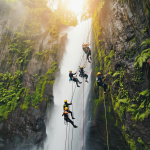
Technical canyoning adds rappelling, downclimbing, and sometimes swimming through narrow gorges. The technical gear requirement (harnesses, helmets, ropes, anchor systems) means smaller groups and more experienced guides, which naturally filters the experience toward lower density. If your primary goal is avoiding crowds, technical canyoning routes with a significant rappelling component tend to be less congested than pure waterfall trekking routes, simply because the logistics complexity limits throughput.
When evaluating operators, ask whether the experience is primarily trekking-to-waterfalls or technical descent. Both have value, but they have different crowd profiles.
Step 6: Time Your Booking to Minimize Overlap With Peak Traffic Windows
Even on a genuinely low-traffic route with an excellent operator, timing can make a significant difference in your experience. Costa Rica’s adventure tourism has predictable crowd patterns that you can work with once you understand them.
The highest-density windows for canyoning near Jacó are:
- December 26 – January 5: North American holiday peak. Every popular route is operating at maximum capacity.
- Semana Santa (Holy Week, the week before Easter): Costa Rica’s biggest domestic travel week. Combines international visitors with local families, creating double-peak conditions.
- US school spring break (mid-March to mid-April): Heavy US college and family travel, concentrated in Jacó and the Central Pacific due to the beach-adventure combination.
- Cruise ship port days at Caldera: Multiple ships dock weekly during dry season. Shore excursion blocks run 9 a.m.–3 p.m. If you can identify the port schedule (it’s publicly available through cruise line itinerary pages) and book outside those windows, you’ll immediately access a different density tier.
The lowest-density windows for quality canyoning are early green season (May–June), when rains have begun but are not yet overwhelming, and late green season (October–November), when volumes are lowest and operators are often willing to offer more flexible, personalized arrangements. Water volumes during these periods require a competent operator who adjusts routes based on conditions, but the canyon experience itself is often richer: more dramatic waterfalls, greener vegetation, and genuinely empty trails.
The Early Morning Advantage
Many experienced travelers in Costa Rica have discovered what local operators call the “golden window”: departures at 6–7 a.m. that put you in the canyon before the 9 a.m. wave of standard tours. In a canyon system, an hour of head start translates to complete solitude for the first half of the route. Even on routes that aren’t inherently exclusive, an early departure with a flexible operator can deliver the uncrowded experience you’re looking for.
Not all operators offer early departures, particularly those serving cruise passengers or hotel guests who don’t want to wake at 5 a.m. This makes early departure availability a useful filter: operators who offer it tend to be more client-focused and less volume-dependent.
Step 7: Vet Safety Standards Independently of Crowd Claims
It’s a common mistake to conflate “uncrowded” with “safe.” Some of the least crowded canyoning experiences in Costa Rica are least crowded because they operate outside the regulatory framework that established operators navigate. An unlicensed guide taking three tourists down an unpermitted canyon route in a remote section of Puntarenas province may deliver a genuinely wild, crowd-free experience, but the risk profile is fundamentally different from a permitted operation with trained guides and proper equipment.
Crowd avoidance and safety are not in conflict, but they require independent evaluation. Use the ICT registration check described in Step 4, and add these specific safety vetting steps:
- Ask about guide first-aid certification. At minimum, guides should hold Wilderness First Responder (WFR) or an equivalent certification recognized in Costa Rica. Ask for the certifying body, not just a yes/no answer.
- Ask about equipment inspection protocols. Harnesses, ropes, carabiners, and helmets used in canyoning have rated service lives. Ask when equipment was last formally inspected and what the replacement schedule is.
- Verify rescue access. On a remote or off-the-beaten-path route, what is the evacuation plan if someone is injured? A responsible operator should be able to describe the route to the nearest medical facility (for Jacó, that’s generally Hospital Monseñor Sanabria in Puntarenas, or private clinics in the Jacó area for non-critical care) and the communication protocols in use.
- Check for liability waivers and what they cover. Costa Rican adventure tourism operators use waivers, but the presence of a waiver doesn’t tell you about the operator’s actual insurance coverage. Ask whether they carry commercial liability insurance for adventure activities, and ask for the name of the insurer if you want to verify.
Step 8: Evaluate the Ecological Integrity of the Route
For travelers interested in genuine off the beaten path Costa Rica experiences, ecological integrity is often as important as solitude. A canyon that has been accessed by hundreds of groups shows it: compacted soil on approach trails, disturbed riparian vegetation, habituated wildlife that no longer exhibits natural behavior, and in some cases visible erosion at rappel anchor points.
An operator who genuinely cares about the ecological condition of their routes will limit annual visitor numbers per section, rotate between multiple access points to allow vegetation recovery, and train guides to actively minimize impact. These practices are consistent with Costa Rica’s Ley de Biodiversidad (Law No. 7788), which establishes obligations for sustainable use of biological resources, and with SINAC’s management guidelines for conservation areas.
Ask the operator directly: “How many groups access this specific route per year, and do you have any rotation or rest protocols?” An operator who has thought seriously about this will have a real answer. An operator who hasn’t will change the subject.
Recognizing Genuine Ecotourism vs. Eco-Washing
Costa Rica’s reputation for ecotourism has created a market for “eco” branding that isn’t always substantiated. The most reliable third-party signal is the CST (Certificación para la Sostenibilidad Turística) rating, administered by the ICT. CST rates tourism businesses on a scale of 1–5 leaves across four dimensions: physical-biological environment, management of the service company, external client, and socioeconomic environment. A company with a CST rating of 3 or above has been independently verified across all four dimensions. A company that claims to be sustainable without any CST or equivalent certification is making an unverified claim.
That said, many excellent small operators are in the process of pursuing CST certification or have not yet applied. The absence of CST isn’t automatically disqualifying, particularly for very small operations. What matters is whether the operator can articulate specific practices that align with genuine sustainability principles rather than just using the vocabulary.
Step 9: Use the Pre-Trip Briefing as a Final Quality Check
Once you’ve booked, the pre-trip briefing is your last opportunity to confirm you’ve made the right choice. A well-organized operator provides a detailed briefing that covers safety protocols, gear fitting, route overview, physical demands, and what to expect at each technical section. This briefing is also a window into the guide’s actual knowledge and the operator’s organizational discipline.
During the briefing, pay attention to these specific signals:
- Does the guide describe the route in specific terms? References to particular landmarks, pools, or ecological features indicate genuine route familiarity rather than scripted delivery.
- Is gear fitting done individually? Harness and helmet fitting should be done person-by-person, not handed out en masse with a “adjust as needed” instruction. Individual fitting takes more time but is a clear indicator of safety culture.
- How does the guide explain the technical sections? A guide who describes rappel technique in terms of body position, weight distribution, and brake hand placement is demonstrating real technical knowledge. A guide who says “just lean back and walk down” is not.
- Are ecological and cultural context points included? In Costa Rica’s richest canyon ecosystems, a knowledgeable guide will note specific plant species (look for Heliconia along riparian corridors), bird calls (the unmistakable sound of the Montezuma oropendola or the turquoise-browed motmot), and the geological story of the canyon formation. This depth of briefing indicates a guide who genuinely knows the terrain, not just the rope work.
How Adventure Tours in Jacó, Costa Rica Fit Into This Framework
Jacó’s position on the Central Pacific coast makes it one of the most strategically located bases for canyoning and waterfall adventures in the country. Within a 45-minute drive of town, the terrain transitions from Pacific coastal lowlands through premontane rainforest into canyon systems that drain the western slopes of the Fila Costeña. This compressed vertical transition means extraordinary biodiversity within a short distance: within a single morning’s drive from Jacó, you can move through multiple ecological zones that elsewhere in Costa Rica would require a full day of travel to access.
The best adventure tours in Jacó, Costa Rica use this geography intelligently. Rather than taking every group to the same accessible waterfall, experienced operators map routes that use the elevation gradient creatively: starting in lower tropical dry forest, ascending through premontane wet forest, and accessing canyon sections that are physically isolated from the road-accessible sites most operators rely on. The difference in experience is not incremental. It’s categorical.
Operators based in Jacó with deep local roots also have something that newer or externally managed companies lack: relationships. Relationships with landowners who grant access to private canyon systems. Relationships with SINAC rangers who provide current information on trail conditions in adjacent conservation areas. Relationships with local communities in the Fila Costeña foothills whose members often serve as the most knowledgeable guides available. These relationships take years to build and can’t be replicated by an operator who sets up shop in Jacó with a van and a set of harnesses.
The most uncrowded canyoning experiences in Costa Rica’s Central Pacific region aren’t found through better search engine queries. They’re found through operators who have earned access to places other operators haven’t reached yet, and who protect that access by limiting the number of people they bring through.
What to Expect on a Genuinely Off-the-Beaten-Path Canyoning Route
For travelers who haven’t experienced the difference between a standard canyoning tour and a genuinely low-traffic route, it helps to understand concretely what changes. The rappelling mechanics are the same. The safety protocols are the same or better. What changes is everything around the technical activity itself.
On an uncrowded route, you hear the canyon. The sound profile of a tropical canyon system with no other human voices is remarkable: the baseline roar of moving water, layered with bird calls that shift by elevation and time of morning, with occasional punctuation from howler monkeys or coatis moving through the canopy above the gorge walls. On a crowded route, you hear the group. The social experience is fine, but the ecological immersion is gone.
Wildlife behavior changes dramatically with foot traffic. Mammals, birds, and reptiles habituate to regular human presence on heavily used routes, which means you see them in abnormal contexts (a white-nosed coati begging for food near a rappel station, a basilisk lizard that doesn’t flee). On routes with genuinely low visitation, wildlife encounters are sudden, unscripted, and often extraordinary: a fer-de-lance crossing the approach trail at dawn, a pair of resplendent quetzals if you’re high enough in the Talamanca foothills, a river otter working a pool at the base of a waterfall.
The pools themselves are different. Heavily visited waterfall pools in Costa Rica show the wear of thousands of visitors: disturbed bottom sediment, reduced aquatic life, occasional litter despite guides’ best efforts. Pools on low-traffic routes have clear water columns, visible fish and invertebrate communities, and the mossy, undisturbed character that makes Costa Rica’s waterfall environments genuinely special.
Frequently Asked Questions About Finding Uncrowded Canyoning in Costa Rica
How do I find guided canyoning experiences that avoid crowded tourist spots?
The most reliable approach is to contact operators directly before booking and ask specific questions about group size caps, land access arrangements, and whether other tour groups will be present on the route simultaneously. Use the operator evaluation framework in this guide to filter responses. Avoid booking solely based on review volume, since the most-reviewed operators tend to run the highest-traffic routes.
Is canyoning in Costa Rica safe for beginners?
Yes, with the right operator. Look for ICT-registered companies with guides who hold recognized first-aid certifications (Wilderness First Responder or equivalent), equipment inspection protocols, and clear rescue plans. Beginner-friendly routes exist across the Central Pacific region, including near Jacó, that involve manageable rappel heights and swimming sections without requiring prior technical experience.
What is the best time of year to go canyoning in Costa Rica to avoid crowds?
Early green season (May–June) and late green season (October–November) have the lowest visitor volumes on most routes. If you visit during dry season (December–April), book early morning departures (6–7 a.m.) and avoid peak cruise ship days at the Caldera port. Mid-week departures are generally less crowded than weekends regardless of season.
How much does a guided canyoning tour near Jacó cost?
Prices vary based on route length, technical complexity, and group size. Standard group canyoning tours in the Jacó area generally range from $75–$120 USD per person. Private tours or routes that access more remote terrain typically run $150–$250 USD per person or more. Be cautious of pricing significantly below the market range, as it often signals cost-cutting on guides, equipment, or insurance coverage.
What’s the difference between canyoning and waterfall trekking in Costa Rica?
Waterfall trekking involves hiking to waterfalls, typically with swimming opportunities, on established trails. Canyoning adds technical elements: rappelling down waterfall faces, downclimbing rock sections, and sometimes swimming through narrow gorges. Technical canyoning requires specialized gear and trained guides, and naturally limits group size more than standard waterfall trekking.
Do I need to be physically fit for canyoning near Jacó?
A basic level of fitness helps. Most beginner-to-intermediate canyoning routes in the Central Pacific region involve 1–3 hours of hiking on variable terrain plus rappelling sections. You don’t need to be an athlete, but you should be comfortable walking on uneven ground for extended periods and have no significant fear of heights. Ask your operator to describe the physical demands specifically before booking.
How do I verify that a Costa Rica tour operator is legitimate?
Ask for their ICT (Instituto Costarricense de Turismo) registration number and cross-reference it on the ICT’s official registry. Ask about their guide certifications, insurance coverage, and SETENA compliance for any environmental impact obligations. Legitimate operators are transparent about these details and can provide documentation on request.
Are there canyoning routes near Jacó that access private land?
Yes. Several experienced operators in the Jacó area have negotiated access agreements with private landowners in the Fila Costeña foothills, allowing access to canyon sections that aren’t part of the standard SINAC-permitted route network. These private access arrangements are often the strongest guarantee of genuinely uncrowded experiences. Ask operators directly whether their route crosses private or protected land and how that access is managed.
What should I bring on a canyoning tour in Costa Rica?
Operators provide technical gear (harness, helmet, ropes). You should bring: athletic clothing that can get wet (synthetic fabrics, not cotton), secure footwear (closed-toe shoes that can get wet, or ask if the operator provides water shoes), sunscreen (reef-safe formulations are strongly preferred near waterways), a dry bag or waterproof case for electronics, water (at least 2 liters for a half-day tour), and a light snack. Leave valuables at your accommodation.
Can cruise passengers from Caldera do a canyoning tour near Jacó?
Yes. Jacó is approximately 30 minutes from the port of Caldera, making it one of the most accessible adventure destinations for cruise shore excursions. A half-day canyoning tour (3–4 hours including transport) fits comfortably within a typical port day window. Book in advance and confirm return time guarantees with the operator before committing.
What ecological protections apply to canyoning routes in Costa Rica?
Costa Rica’s Ley de Biodiversidad (Law No. 7788) and Ley Forestal (Law No. 7575) establish protections for biodiversity and forested areas. SINAC manages conservation areas and issues permits for commercial tourism activities within protected zones. SETENA oversees environmental impact assessments. Responsible operators navigate this regulatory framework and can describe their compliance status clearly.
How do I know if a “hidden waterfall” tour is genuinely off the beaten path?
Ask the operator to describe specifically why other groups won’t be present on the route: is it a private land agreement, a timed access protocol, a route that requires a longer approach that filters out volume operators, or a permitted-only section of a conservation area? If the operator can’t give you a specific, logistically plausible answer, the “hidden” marketing language is likely just branding.
Key Takeaways
- Crowded canyoning routes in Costa Rica result from a convergence of permitting concentration, insurance requirements, and guide training defaults. Understanding this helps you identify operators who have genuinely broken the pattern.
- Build your operator evaluation framework before searching. The channels most travelers use are algorithmically biased toward high-volume operators, not high-quality ones.
- The seven pre-booking questions in Step 4 are your most reliable filter. Operators who access genuinely uncrowded terrain answer them specifically. Others deflect.
- ICT registration and CST certification are the two most reliable third-party quality signals for Costa Rican adventure tour operators.
- Early morning departures (6–7 a.m.) can deliver uncrowded experiences even on routes that aren’t inherently exclusive, by placing you in the canyon before the standard tour wave.
- Technical canyoning routes with significant rappelling components are structurally less crowded than waterfall trekking routes, due to the logistics complexity that limits throughput.
- Ecological integrity and crowd avoidance go together. Routes that operators manage sustainably tend to remain genuinely uncrowded over time, while over-accessed routes degrade the experience for everyone.
- Jacó’s location on the Central Pacific coast provides access to canyon systems across multiple ecological zones within a short drive, making it one of the best bases in Costa Rica for finding genuinely off-the-beaten-path canyoning experiences.
Finding the right canyoning experience in Costa Rica requires more effort than clicking “book now” on the first result, but the payoff is proportional. An empty canyon at dawn, a waterfall that you’re genuinely the first people to visit that week, a guide who stops mid-route to point out a poison dart frog on a mossy boulder without making it feel like a scripted moment: these are the experiences that become the stories people tell for years after the trip.
Ready to find that experience near Jacó? Explore the adventure tours offered by Costa Rica Waterfall Tours and reach out directly to ask the questions that matter. The right operator will be glad you asked them.
About the author
Costa Rica Waterfall Tours Editorial Team · Editorial Team
Book Your Guided Waterfall Adventure