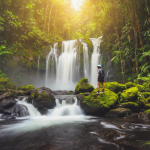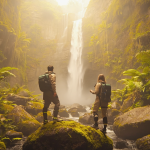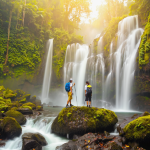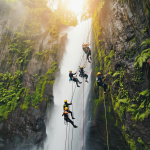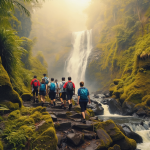
Picture this: you’re standing at the lip of a 25-metre waterfall deep in the rainforest above Jacó, the roar of white water filling the canyon below you, a harness snug around your waist, and a guide calmly explaining exactly how your feet should contact the rock face. Behind you, the jungle presses in thick and green. Ahead, the only way is down. That precise moment, suspended between rational hesitation and full-body exhilaration, is what canyoning is.
It is not waterfall trekking. It is not a scenic hike with a pool at the end. Canyoning is a discipline that asks you to move through the water, not merely beside it, descending gorges using a combination of rappelling, swimming, sliding, and jumping. And Costa Rica, specifically the Central Pacific corridor anchored by Jacó, has quietly become one of the most compelling destinations on the planet to do it.
This guide breaks down exactly what canyoning involves, how it compares to waterfall hiking, what each demands of your body and your nerve, and why the Central Pacific region delivers on both counts better than any other part of the country. Whether you are a cruise passenger with a single shore-excursion window, a week-long adventure traveler trying to pack in as much as possible, or a family weighing options for kids of different ages, this is the clearest map you will find to making the right call.
What Canyoning Actually Is (and What People Get Wrong About It)
Canyoning, also called canyoneering in North America, is the sport of navigating a river canyon by descending through it using technical and semi-technical methods: rappelling on fixed ropes, swimming through gorge pools, sliding down natural rock chutes, and making controlled jumps into plunge pools. The discipline originated in the slot canyons of southern Europe and the American Southwest and has since spread wherever geology creates narrow, water-carved passages through rock.
The most common misconception is that canyoning is just an extreme version of waterfall hiking. It is not. Waterfall hiking takes you to a waterfall. Canyoning takes you through the waterfall system itself. You are inside the canyon, not looking at it from a viewpoint trail. You get wet, often very wet. You use ropes. You navigate obstacles that cannot be walked around. The terrain dictates the technique, not the other way around.
The Four Core Techniques You Need to Understand
- Rappelling (abseiling): Descending a rope anchored above while your feet walk down a vertical or near-vertical surface. In canyoning, this often means descending directly through or beside falling water. The sensation is unlike any gym wall or dry-rock climbing scenario.
- Tobogganing: Using smooth, water-polished rock as a natural water slide. Many Costa Rican canyons have basalt or granite sections worn so smooth by centuries of flow that they function as natural slides into deep pools. No equipment required, only nerve.
- Jumping: Cliff and ledge jumps into plunge pools are standard in most canyoning routes. Jump heights vary widely, from 2–3 metres on beginner routes to 10+ metres on advanced descents. Guides assess pool depth and landing zones before every jump.
- Swimming: Some sections of a canyon can only be crossed by swimming through gorge pools or wading upstream. A well-fitted personal flotation device (PFD) is standard on any reputable tour.
In Costa Rica, canyoning routes also frequently pass through active waterfall systems, meaning you may rappel directly under or through a curtain of falling water. That is a sensory experience with essentially no equivalent in any other adventure sport.
How Costa Rican Geology Creates Ideal Canyoning Terrain
Costa Rica sits on the convergence of the Cocos Plate and the Caribbean Plate, producing the volcanic arc that runs through the country’s spine. This geological activity has created deeply incised river gorges, particularly on the Pacific slope, where rivers descend rapidly from the Cordillera Central and Cordillera de Talamanca toward the coast. The Central Pacific region, including the watersheds draining toward Jacó and Quepos, features exactly the right combination of gradient, rock hardness, and water volume to produce technically interesting canyon descents at multiple difficulty levels.
The basalt and andesite formations common in this zone are hard enough to hold anchors reliably and smooth enough from water erosion to create natural slides and pools. Seasonal water volume, driven by Costa Rica’s pronounced dry season (December through April, locally called verano) and rainy season (May through November, invierno), means the character of a canyon changes dramatically by month. High-water season produces more dramatic falls and faster currents. Low-water season exposes more rock features and makes technical sections more accessible for beginners.
Waterfall Hiking in Costa Rica: What It Offers and Who It Suits
Waterfall hiking, or waterfall trekking, is the more accessible sibling of canyoning. The goal is to reach one or more waterfalls via a forest trail, with the payoff being a swim in a natural pool, dramatic photography, and the sensory experience of being close to falling water in a jungle setting. No ropes, no harnesses, no mandatory swimming. Just boots, a trail, and some elevation change.
Costa Rica is exceptional waterfall hiking territory. The country’s Sistema Nacional de Áreas de Conservación (SINAC) protects over 25% of the national territory, and a significant portion of the country’s most spectacular waterfalls sit within or adjacent to those protected areas. The Central Pacific region alone hosts dozens of named falls within easy reach of Jacó, ranging from roadside cascades to multi-hour jungle hikes that reward effort with genuinely remote, uncrowded pools.
What a Typical Waterfall Hike Looks Like
A guided waterfall hike from Jacó typically involves a vehicle transfer into the forest, a walk ranging from 30 minutes to 2.5 hours depending on the route, and arrival at one or more waterfall viewpoints or swim spots. Trail conditions vary significantly. Some routes use well-maintained paths with wooden bridges and handrails. Others involve scrambling over wet roots, crossing streams on stepping stones, and navigating steep, muddy slopes with the help of fixed ropes or guide assistance.
The physical demands are real but accessible. Most healthy adults, including older travelers and those with moderate fitness, can complete a waterfall hike with proper footwear and pacing. Families with children aged 8 and up typically manage well-chosen beginner routes. The biggest physical variables are heat, humidity, and trail conditions, all of which are managed more easily with an experienced local guide who knows which routes are appropriate by season and group ability.
Why Waterfall Hiking Still Deserves Its Own Spotlight
The temptation in a comparison article like this is to position waterfall hiking as the “lesser” option for people who are not ready for canyoning. That framing is wrong. Waterfall hiking has distinct advantages that canyoning cannot replicate:
- Ecological immersion: A longer trail means more time in the forest, more wildlife sightings, more opportunities for a guide to explain the ecosystem. Canyoning moves fast through technical terrain. Hiking moves at a pace that allows observation.
- Photography: Shooting long-exposure waterfall photos from a stable viewpoint, with the ability to recompose and wait for light, is far easier on a hiking trail than mid-rappel in a canyon. The Central Pacific’s waterfalls are extraordinarily photogenic.
- Inclusivity: Waterfall hikes can be adapted for a much wider range of ages and fitness levels. Families with young children, travelers recovering from injury, seniors, and non-swimmers can all participate meaningfully.
- Stillness: There is a contemplative quality to standing at the base of a large waterfall in a tropical forest that canyoning, by its nature, does not offer. Some travelers come to Costa Rica for that stillness, and waterfall hiking delivers it.
Canyoning vs. Waterfall Hiking: A Direct Feature Comparison
The question most travelers actually want answered is not “what is canyoning?” but “which should I book?” Here is a direct, honest comparison across the dimensions that matter most for planning purposes.
| Factor | Canyoning | Waterfall Hiking |
|---|---|---|
| Minimum age (typical) | 12–14 years (operator-dependent) | 5+ years (route-dependent) |
| Fitness level required | Moderate to high | Low to moderate |
| Swimming ability needed | ✅ Required (PFD provided) | ❌ Not required |
| Technical gear required | ✅ Harness, helmet, descender, PFD | ❌ Trail footwear, daypack |
| You will get wet | ✅ Guaranteed, fully | ⚠️ Optional (swim sections) |
| Typical duration | 3–5 hours with transfers | 2–6 hours depending on route |
| Best season | Dry season (Dec–Apr) for beginners; rainy season for experienced | Year-round; rainy season adds drama |
| Wildlife viewing | ⚠️ Limited (moving fast) | ✅ Strong (slower pace) |
| Photography-friendly | ⚠️ Action shots only; waterproofing required | ✅ Full creative access |
| Adrenaline factor | ✅ Very high | ⚠️ Low to moderate |
| Suitable for non-swimmers | ❌ No | ✅ Yes (most routes) |
| Typical price range (USD) | $75–$140 per person | $45–$95 per person |
Beginner vs. Advanced: How Difficulty Levels Work in Costa Rican Canyoning
One of the most important things to understand about canyoning in Costa Rica is that difficulty is not a binary. There is a spectrum from accessible beginner routes that introduce you to rappelling in a controlled environment all the way to multi-pitch technical descents that require genuine experience and physical conditioning. Knowing where you fall on that spectrum before you book is the difference between a life-highlight experience and a genuinely dangerous situation.
Beginner Canyoning: What to Expect
A well-designed beginner canyoning route in the Central Pacific region will typically involve two to four rappels ranging from 8 to 20 metres, one or two natural water slides, and a pool jump in the 3–5 metre range. The terrain is managed, anchors are pre-rigged, and guides will physically demonstrate every technique before you attempt it. The group moves together, and the pace is controlled to allow nervous participants to acclimatize.
Beginner routes are not without physical demand. You will be moving through water, scrambling over wet rocks, and using muscle groups you probably do not train regularly, particularly the quads and core muscles used to control descent speed on a rope. Expect to feel genuinely tired afterward. But the technical barriers are low, and a good guide makes the difference between anxiety and confidence at every step.
Who beginner canyoning suits: Healthy adults with no prior rappelling experience, travelers who have done zip-lining or other adventure activities and want something more physical, teenagers (typically 14+) with good fitness, and anyone who is comfortable in water and does not have a disabling fear of heights.
Intermediate Canyoning: The Sweet Spot for Returning Adventure Travelers
Intermediate routes introduce longer rappels (20–40 metres), more complex anchor systems, sections that require swimming across pools to access the next descent, and jumps in the 5–10 metre range. The terrain is less managed, requiring participants to read the canyon and make some decisions independently. Guide-to-participant ratios are typically tighter on intermediate routes.
Costa Rica’s Central Pacific gorges produce some of the country’s most compelling intermediate terrain. The combination of volcanic rock formations, multi-tiered falls, and jungle gorge aesthetics creates routes that look extraordinary in photos but also demand real engagement from participants. If you have completed a beginner canyoning tour anywhere in the world, or if you are an experienced rock climber, hiker, or whitewater paddler, intermediate is likely your appropriate entry point.
Advanced Canyoning: Technical and Committing
Advanced canyoning in Costa Rica involves rappels exceeding 40 metres (in some cases well over 60 metres), free-hanging descents where your feet leave the rock entirely, complex canyon swims in moving water, and jump points that require precise technique to enter safely. These routes may be done in higher water conditions during the rainy season, adding hydraulic complexity that demands genuine technical skill and physical conditioning.
Advanced routes are not appropriate for first-timers regardless of general fitness level. The risks compound significantly when technical errors occur in complex terrain. Reputable operators in Costa Rica will assess participants’ prior experience before assigning them to advanced routes, and any operator that does not ask about your background before confirming an advanced booking should be a red flag.
The Difficulty Rating Matrix: How to Self-Assess
| Your Background | Recommended Entry Level | Notes |
|---|---|---|
| No prior adventure sports experience | Beginner canyoning or waterfall hike first | Start with hiking to build terrain familiarity |
| Zip-lining, snorkeling, or beach adventures only | Beginner canyoning | Comfortable with outdoors, not yet with vertical terrain |
| Rock climbing, via ferrata, or prior rappelling | Intermediate canyoning | Technical skills transfer well |
| Whitewater kayaking or canyoning experience elsewhere | Intermediate to advanced | Discuss specific routes with the operator |
| Professional outdoor guide or multi-sport athlete | Advanced | Seek operator with technical multi-pitch routes |
Safety Standards in Costa Rican Adventure Tourism: What the Law Requires and What Good Operators Do Beyond It
Safety is the non-negotiable foundation of any canyoning operation, and in Costa Rica, adventure tourism safety is governed by a framework of national regulations that any legitimate operator must comply with. Understanding this framework helps you evaluate operators before you book and ask the right questions when you arrive.
Costa Rica’s Instituto Costarricense de Turismo (ICT) licenses and regulates adventure tourism operators nationwide. ICT licensing requires operators to demonstrate compliance with equipment standards, guide certification, insurance coverage, and emergency protocols. Operators who display current ICT certification have passed a baseline regulatory review. This is a minimum threshold, not a guarantee of excellence, but it is a meaningful filter for eliminating unlicensed operators.
Equipment Standards That Matter
On any legitimate canyoning tour in Costa Rica, the following equipment should be standard issue for every participant:
- Helmet: A properly fitted climbing or canyoning helmet, not a bicycle helmet. Impact resistance from falling rock or contact with canyon walls is the protection goal.
- Harness: A sit harness that distributes load across the hips and upper thighs, not a simple waist belt. Harnesses should be inspected before each use and retired on a schedule regardless of visible wear.
- Descender device: A figure-eight or belay device appropriate for canyoning descent. Auto-locking devices add a safety margin for nervous beginners.
- Personal Flotation Device (PFD): Required for any route with swim sections. Should be properly fitted, not merely available.
- Wetsuit or quick-dry suit: Water temperatures in Costa Rican rivers are warm (typically 22–26°C), but extended immersion during a 3–4 hour descent can produce thermal fatigue without insulation.
- Anchor systems: Fixed anchors in Costa Rican canyons should use stainless steel hardware appropriate for the humid, corrosive environment. Operators who maintain and inspect anchors on a regular schedule rather than replacing them only when visibly damaged are operating to a higher standard.
Guide-to-Participant Ratios and What They Signal
The guide-to-participant ratio on any technical outdoor activity is one of the clearest indicators of operational quality. For beginner canyoning, a ratio of 1 guide per 6–8 participants is an acceptable industry standard. For intermediate and advanced routes, 1:4 or better provides the supervision density needed for safe, responsive guiding in complex terrain.
Guides should also carry a comprehensive first-aid kit appropriate for remote canyon environments, have training in wilderness first aid or its equivalent, and have a clear communication protocol for emergency evacuation. Ask your operator directly: what is the emergency evacuation plan if a participant is injured in the canyon? A good operator will have a specific, practiced answer.
Environmental Compliance and the Role of SETENA
Adventure tourism operations in Costa Rica that operate within or adjacent to protected areas must obtain environmental permits through SETENA (Secretaría Técnica Nacional Ambiental), the national environmental impact assessment authority. Operations affecting rivers, waterfalls, or forest zones within SINAC-managed conservation areas also require specific concession agreements. Operators who are SETENA-compliant have demonstrated that their activities meet environmental impact thresholds, including limits on group size, anchor placement, and trail disturbance that protect the canyon ecosystem for future visitors.
The Certificación para la Sostenibilidad Turística (CST), administered by ICT, is the gold standard for sustainable tourism operations in Costa Rica. A CST-rated operator has been independently assessed across four dimensions: the physical-biological environment, the infrastructure and services, the management of external clients, and the socio-economic environment. CST certification is not a marketing label, it is a rigorous audit process. When choosing between operators, CST status is a meaningful differentiator.
Why the Central Pacific Is the Best Base for Canyoning and Waterfall Adventures
Costa Rica has canyoning and waterfall experiences in multiple regions. The Arenal Volcano area around La Fortuna offers excellent adventure infrastructure. The Monteverde cloud forest has its own character. Tortuguero’s Caribbean side is ecologically extraordinary. But for the specific combination of canyoning quality, logistical convenience, and overall adventure variety, the Central Pacific region, centered on Jacó, makes the strongest case.
Geographic Proximity and Route Density
Jacó sits approximately 100 kilometres southwest of San José along the Costanera Sur highway, a drive of roughly 1.5–2 hours from Juan Santamaría International Airport. This proximity makes it the most accessible major adventure hub from the country’s primary international entry point. More importantly, the mountain watershed immediately behind Jacó, rising into the Fila Chonta and the broader Pacific slope of the Cordillera de Talamanca, contains an exceptional density of canyon systems and waterfall sequences within a 30-kilometre radius of town.
This route density matters because it means operators can offer multiple distinct experiences across different difficulty levels without requiring participants to commit to multi-hour transfers. A beginner group can access a well-managed beginner canyon in under 45 minutes from Jacó. An advanced group can reach genuinely technical terrain within the same window. The variety within close range is not matched in most other Costa Rican adventure zones.
Year-Round Operational Viability
The Central Pacific’s climate, while sharing Costa Rica’s two-season structure, is somewhat more forgiving for adventure tourism than the wetter Caribbean coast or the high-altitude cloud forest zones. The dry season from December through April delivers reliable conditions for beginners attempting canyoning for the first time. Lower water volumes make canyon descents more controlled, anchor systems are easier to access, and natural slides and pools are more defined.
The rainy season (May through November) transforms the same canyons into more dramatic, higher-volume systems. Experienced canyoners specifically seek out rainy-season descents for the full-power waterfall experience. Reputable operators adjust their route offerings seasonally, routing beginners to appropriate terrain even when primary routes are running at high volume. This adaptive programming is itself a safety feature.
Adventure Ecosystem Depth
Beyond canyoning and waterfall hiking specifically, the Central Pacific offers the kind of multi-activity ecosystem that allows travelers to combine experiences intelligently across a multi-day stay. Surfing at Jacó Beach, sport fishing out of Herradura, wildlife watching at Carara National Park (one of the few places in Costa Rica where the range of scarlet macaws and blue-headed parrots overlaps), kayaking the Tárcoles River estuary, and ocean excursions along the Nicoya Peninsula coast can all be layered around canyoning and waterfall days. For travelers who want to maximize the variety of a Costa Rica trip, the Central Pacific delivers more options per square kilometer than anywhere else in the country.
What to Wear, What to Bring, and What to Leave at the Hotel
Preparation for canyoning and waterfall hiking in the Central Pacific is specific enough that generic “what to pack for Costa Rica” lists will leave you either underprepared or carrying things you do not need. Here is a precise, experience-based breakdown for each activity type.
Canyoning Packing and Preparation
Your operator will provide all technical gear (harness, helmet, descender, PFD, wetsuit or splash jacket). What you bring from your accommodation needs to complement what they provide:
- Footwear: Closed-toe shoes with a secure fit that you are comfortable getting completely wet. Water sandals with heel straps work. Old running shoes work. Open-toed sandals and flip-flops do not, under any circumstances.
- Swimwear: Worn under your wetsuit or splash jacket. Board shorts and a rash guard are ideal. Avoid anything with exposed metal hardware that can catch on rock.
- Quick-dry shirt or rash guard: Worn under the wetsuit. A rash guard also reduces wetsuit-induced skin irritation on longer descents.
- Dry bag or waterproof case for your phone: If you want photos, bring a waterproof case. Assume everything in your pockets will be submerged at some point.
- Small towel: For the return transfer. Your operator may provide one, but confirm in advance.
- Water bottle: Physical exertion in tropical heat requires consistent hydration. Bring a full bottle; your operator may provide refills, but do not assume so.
- Snack: A 3–4 hour canyoning session burns significant energy. A compact, non-perishable snack that can survive moisture (energy bars, nuts) is worth carrying.
Leave at the hotel: Jewelry, expensive cameras without full waterproof protection, prescription glasses without a secure strap, and any medication that cannot tolerate moisture. If you wear contact lenses, discuss water immersion with your guide, as repeated submersion in river water carries a small risk of eye irritation or infection.
Waterfall Hiking Packing and Preparation
- Footwear: Waterproof or water-resistant trail shoes or hiking boots with ankle support. Grip is critical on wet jungle trails. Avoid smooth-soled sneakers.
- Clothing: Lightweight, moisture-wicking fabrics. Long pants protect against scratches and insects on denser trails. A lightweight rain jacket is useful in the rainy season.
- Insect repellent: Apply before departure. DEET-based repellents are most effective but should be applied to skin only, not clothing or gear that contacts the forest.
- Sunscreen: Apply before departure and carry a reef-safe formula for waterfall swim sections. Standard chemical sunscreens are harmful to aquatic ecosystems; mineral sunscreens (zinc oxide, titanium dioxide) are the responsible choice in natural pools.
- Camera: Waterfall hikes are photography-friendly. A full-size camera is manageable on most routes. Bring a microfiber cloth for lens moisture.
- Change of clothes: Even if you do not plan to swim, stream crossings and rain can leave you wetter than expected. A dry change for the return is always worth carrying.
Adventure Tours in Jacó: The Operator Landscape and How to Choose Wisely
Jacó has a mature adventure tourism market. There are operators ranging from highly professional, safety-first companies with years of operating history and strong review records to informal operations that have assembled equipment and marketed tours without the underlying infrastructure to run them safely. The difference is not always obvious from a website or a social media profile. Knowing what to look for protects both your safety and your experience quality.
Five Questions to Ask Any Canyoning Operator Before Booking
- Are you licensed by ICT? Ask for the license number if you want to verify independently. Legitimate operators are proud to provide it.
- What is your guide-to-participant ratio for this route? Ratios higher than 1:8 for technical terrain should prompt a follow-up question about supervision protocols.
- How recently were your anchors inspected and by whom? Professional operators have a documented anchor inspection schedule and can describe it. Vague answers are a warning sign.
- What is your emergency evacuation protocol? “We call for help” is not an answer. A real protocol involves specific contact numbers, helicopter landing zone awareness, and first-aid-trained guides.
- Can I speak to a guide about the specific route before I commit? Operators who allow (or encourage) pre-booking conversations with guides demonstrate confidence in their team and transparency about what participants will experience.
Reviews as Signal, Not Guarantee
High review volume on Google or TripAdvisor is a useful signal of operational consistency. An operator with several hundred four- and five-star reviews has demonstrably delivered positive experiences at scale. Look specifically for reviews that mention safety protocols, guide knowledge, and how the operator handled problems, not just reviews that describe the scenery or say it was “amazing.” How an operator responds to negative reviews is also diagnostic: operators who engage constructively with critical feedback show the kind of operational maturity that translates to good decision-making in the field.
Costa Rica Waterfall Tours, operating out of Jacó with a track record built across hundreds of guided excursions, exemplifies the kind of operator that combines technical competence with genuine local expertise. Their guides’ knowledge of the Central Pacific watershed, seasonal conditions, and appropriate route selection by group ability reflects the kind of on-the-ground experience that makes the difference between a tour that goes well and one that goes exceptionally well. If you are ready to explore what this region offers, their adventure tours page is the right starting point for building your itinerary.
Planning by Traveler Type: Scenario-Based Recommendations
The right adventure experience depends heavily on who you are, who you are traveling with, and what you are hoping to feel by the end of the day. Here are honest, specific recommendations by traveler scenario.
If You Are a Cruise Passenger with 6–8 Hours in Jacó
Cruise ships calling at the Caldera port near Puntarenas put passengers within easy reach of Jacó. With a half-day window, a beginner canyoning tour or a guided waterfall hike is a realistic and rewarding choice. Canyoning will use most of your time window but delivers a dramatically memorable experience for the brief shore excursion budget you have. A waterfall hike gives you slightly more flexibility on timing and is easier to adapt if your group has variable fitness levels. Either way, book in advance, confirm transfer logistics with your operator, and build in buffer time for the return to the port.
If You Are a Family with Children Ages 8–14
A guided waterfall hike is the right call for younger children (8–11). It is physically accessible, ecologically engaging, and allows adults to manage pace for slower or more cautious kids without holding up a technical group. Children aged 12–14 who are confident in water and have some outdoor experience can often access beginner canyoning, but confirm the operator’s minimum age policy and ask specifically whether the route involves mandatory jumps or sections that cannot be bypassed, as these can be genuinely distressing for children who are not ready for them.
If You Are a Solo Traveler on an Adventure Itinerary
Intermediate canyoning on your second or third day in the Central Pacific, after a waterfall hike to orient yourself to the terrain on day one, is an excellent progression. Solo travelers joining group tours find canyoning to be unusually social, the shared adrenaline of technical descents creates fast rapport with strangers in a way that few other activities do. If photography is part of your agenda, do the waterfall hike first for shooting, then the canyon for the pure physical experience.
If You Are an Experienced Adventure Traveler Looking for the Real Thing
Talk directly to operators about their advanced route inventory before committing to any specific tour. The Central Pacific has technical canyon terrain that is genuinely demanding for experienced canyoners, but not every operator runs it as a scheduled product. Some advanced descents are run as private or semi-private tours for small groups with verified experience. Be specific about your background (prior canyoning, rock climbing, whitewater experience) and ask what route will actually challenge you. A good operator will give you an honest answer rather than upselling you into a beginner tour that will leave you bored.
If You Are a Corporate or Incentive Group
Waterfall hiking is typically the better group activity for corporate teams of mixed fitness and adventure appetite. It is inclusive, the scenery is dramatic without requiring everyone to rappel, and it creates shared experiences without the anxiety that some individuals feel in technical canyoning environments. For teams that have done the research and know their group is adventurous, a combined waterfall hike and beginner canyoning day can be structured as a progressive challenge format that works well for team-building narratives.
The Rainy Season Advantage: Why “Off-Season” Is a Misconception
Many U.S. travelers default to planning Costa Rica trips during the dry season (December through April) on the assumption that rain means a ruined trip. This assumption undersells the rainy season significantly, particularly for adventure tourism.
During Costa Rica’s invierno (May through November), the Central Pacific receives substantial rainfall that transforms both the waterfall and canyoning landscape. Waterfalls that run at perhaps 40% of their peak volume in March are at full, thundering capacity by September. The forest is at its most lush and deeply green. Wildlife activity, particularly for reptiles, amphibians, and migratory birds, peaks during the wetter months. And the tourism crowds thin considerably, meaning you are more likely to have a waterfall pool or canyon section to yourself.
The practical consideration for adventure tourism is that rainy-season conditions require operators to make more active route management decisions. A responsible operator will not run a beginner group down a canyon that has overnight rainfall has pushed to flood stage. But they will redirect that group to an appropriate alternative. The operational sophistication to make those calls, and the route inventory depth to offer alternatives, is a meaningful differentiator between mature operators and newer entrants to the market.
For experienced canyoners specifically, the rainy season is often preferred. High water volume adds hydraulic complexity and dramatic visual scale that dry-season conditions simply cannot replicate. If you are planning an advanced descent, May through October provides the conditions that make Costa Rica’s canyons genuinely world-class.
Frequently Asked Questions About Canyoning and Waterfall Hiking in Costa Rica
Do I need prior experience to go canyoning in Costa Rica?
No prior experience is required for beginner-level canyoning tours. Reputable operators provide full equipment, thorough on-site instruction, and guide support throughout the descent. That said, basic swimming ability and a reasonable comfort level with heights are important. Discuss any concerns with your operator before booking.
What is the minimum age for canyoning?
Most operators in Costa Rica set a minimum age of 12–14 years for canyoning, depending on the route and the child’s physical development and maturity. Waterfall hiking has lower minimums, often 5–8 years depending on the trail. Always confirm the operator’s specific policy before booking with children.
Is canyoning safe in Costa Rica?
Canyoning carries inherent risk, as does any technical adventure sport. The risk is substantially managed by booking with an ICT-licensed operator who uses properly maintained equipment, employs certified guides, and runs routes appropriate to participants’ experience levels. Operators who cut corners on any of these dimensions present unacceptable risk. Ask specific questions about licensing, equipment maintenance, and emergency protocols before committing to any tour.
What is the difference between canyoning and canyoneering?
The terms describe the same sport. “Canyoning” is the standard term in Europe, Australia, and Latin America. “Canyoneering” is more common in North America, particularly in the American Southwest. In Costa Rica, you will encounter both terms used interchangeably, with canyoning being more prevalent in Spanish-language and international tourism contexts.
When is the best time to visit Jacó for adventure tours?
The dry season (December through April) offers the most reliable conditions for beginners attempting canyoning for the first time. The rainy season (May through November) is preferred by experienced canyoners for higher water volume and more dramatic conditions. Waterfall hiking is excellent year-round, with rainy-season visits delivering the most visually dramatic falls. The shoulder months (November–December and April–May) can offer a useful combination of manageable conditions and reduced crowds.
How physically fit do I need to be for a canyoning tour?
Beginner canyoning requires a baseline level of fitness comparable to a moderate hiking day. You should be able to walk over uneven terrain for 1–2 hours, swim in calm water, and handle the physical demands of controlling your descent on a rope. You do not need to be an athlete. Intermediate and advanced routes require progressively higher fitness levels; discuss your condition honestly with the operator when booking.
Can I bring my camera canyoning?
Only if it is fully waterproof. Assume any camera that enters a canyon will be submerged. GoPro-style action cameras in waterproof housings are the standard choice. Full-frame DSLRs and mirrorless cameras are not appropriate unless in a purpose-built waterproof housing. Some operators have photography-specific add-ons where a dedicated guide captures the group on a waterproofed action camera and provides footage afterward.
What happens if it rains during my tour?
Light to moderate rainfall during a waterfall hike or canyoning tour is normal and does not typically stop the activity. Heavy rainfall that has raised river levels to unsafe thresholds will prompt route modification or, in rare cases, postponement. Reputable operators monitor conditions actively and have pre-established decision criteria for route changes. Always ask your operator about their weather policy and what happens if a tour is modified or cancelled due to conditions.
Is it better to book adventure tours in advance or on arrival in Jacó?
Booking in advance is strongly recommended, particularly during dry season (December through April), when tour slots fill quickly. Advance booking also allows you to complete any required waivers, confirm equipment sizes, and coordinate logistics from your accommodation or cruise ship. Walk-in bookings are sometimes available during quieter periods but carry the risk of missing your preferred date or tour type.
Are waterfall hikes or canyoning tours appropriate for people with fear of heights?
Waterfall hiking is generally appropriate for people with mild to moderate height sensitivity, as most trails stay on terrain rather than exposed edges. Canyoning involves rappelling, which requires participants to step over canyon edges and descend vertical or near-vertical faces. This is a direct confrontation with height exposure, and anyone with significant acrophobia should discuss this honestly with the operator before booking. Some people find that the controlled, guided nature of rappelling actually helps them work through height anxiety in a structured way; others find it too confronting. Know yourself.
How long does a typical tour take, including transfers?
A full canyoning tour from Jacó typically runs 3–5 hours including ground transfer, gearing up, the descent itself, and return. A waterfall hiking tour typically runs 2.5–5 hours depending on the route’s length and the number of waterfalls visited. Multi-activity days that combine hiking and canyoning with other activities can run 6–8 hours. Confirm total duration when booking and factor in time for showering and changing if you have evening plans.
What should I eat before a canyoning tour?
A moderate meal 1.5–2 hours before departure is recommended. Avoid heavy, fatty meals immediately before physical activity in the heat. Hydrate well the day before and the morning of your tour. If you are prone to motion sickness, the transfer vehicle on mountain roads may be a factor, so consider timing any motion sickness medication accordingly.
Key Takeaways
- Canyoning and waterfall hiking are distinct experiences that suit different travelers. Canyoning is technical, physically demanding, and immersive in a way that no other adventure sport replicates. Waterfall hiking is accessible, ecologically rich, and photogenic for a wider range of participants.
- The Central Pacific, anchored by Jacó, is Costa Rica’s strongest canyoning base thanks to route density, logistical proximity to San José, year-round operational viability, and the depth of the surrounding adventure ecosystem.
- Difficulty levels matter enormously. A beginner canyoning tour is accessible to most healthy adults with no prior experience. An advanced route requires genuine technical background. Self-assess honestly and discuss your level with your operator before booking.
- Safety is operator-dependent. ICT licensing, SETENA compliance, CST certification, maintained equipment, and appropriate guide ratios are the markers of a trustworthy operation. Ask direct questions before you commit.
- The rainy season is not the off-season for adventure tourism. High water volume, lush conditions, and reduced crowds make May through November a compelling time for experienced canyoners and waterfall photographers alike.
- Preparation matters. Proper footwear, swimwear under your wetsuit, a waterproof phone case, hydration, and honest communication with your guide about any physical limitations or concerns are all within your control and all affect the quality of your experience.
- Book in advance. The best operators in the Central Pacific fill their tour slots, particularly in peak season. Advance booking also allows you to prepare properly and coordinate logistics with confidence.
The Central Pacific coast of Costa Rica, from the Pacific-facing slopes above Jacó down to the beach break at the town’s doorstep, packs more adventure variety into a smaller geographic footprint than almost anywhere else in the Americas. Whether you are standing at the top of your first rappel, breathing through the adrenaline, or walking a jungle trail toward the sound of a waterfall you have not yet seen, the experience is shaped by the quality of the people guiding you. Choose well, prepare honestly, and the canyon will take care of the rest.
Ready to book? Explore the full range of adventure tours offered by Costa Rica Waterfall Tours and find the right experience for your group, your timeline, and your appetite for the extraordinary.
About the author
Costa Rica Waterfall Tours Editorial Team · Editorial Team
Book Your Guided Waterfall Adventure