Most travelers arrive in Costa Rica knowing they’re supposed to “travel responsibly.” They’ve seen the phrase on booking sites, in Instagram captions, and in airline sustainability pledges. What they don’t know, and what the tourism industry rarely explains clearly, is what responsible travel actually looks like in the moment you’re standing at a trailhead in the Central Pacific rainforest, deciding which tour company to trust with your morning.
The gap between the buzzword and the behavior is where sustainable adventure travel either succeeds or fails. And Costa Rica, more than almost any other destination on Earth, is the place where that gap is most visible, most consequential, and most instructive.
This is a country where SINAC (Sistema Nacional de Áreas de Conservación) manages over 25% of national territory as protected land. Where the electricity grid runs on more than 99% renewable energy. Where the concept of “ecotourism” was practically invented in the 1980s as a deliberate policy response to deforestation pressure. If sustainable adventure travel means anything real, it means something specific here, and the Central Pacific coast around Jacó is one of the best places in the country to understand why.
This article breaks down what sustainable adventure travel genuinely looks like in practice, how responsible travel in Costa Rica differs from the marketing version of it, and how the choices you make as a traveler ripple outward into ecosystems, communities, and conservation systems you may never see directly.
What Is Ecotourism in Costa Rica, Really?
Ecotourism in Costa Rica is not a marketing label. It is a legal and institutional framework with teeth, administered by the Instituto Costarricense de Turismo (ICT) through a certification system called the Certificación para la Sostenibilidad Turística (CST). Understanding this framework is the first step toward understanding why Costa Rica is genuinely different from destinations that simply borrow the eco-language without the substance.
The CST rates tourism businesses on a scale from zero to five “leaves” across four categories: the physical-biological environment, the infrastructure and services, the external environment management, and socioeconomic impact on local communities. A lodge or tour operator doesn’t earn a CST leaf by writing a mission statement about caring for nature. They earn it through audited practices: water consumption data, waste management records, employment ratios showing preference for local hires, documented relationships with conservation organizations, and verifiable contributions to protected area management.
This is what makes ecotourism in Costa Rica a genuinely instructive model. The country didn’t just decide that nature tourism was good for revenue, though it clearly is. It built institutional infrastructure around the idea that tourism could be a conservation mechanism rather than a consumption mechanism. The distinction matters enormously when you’re trying to understand what you’re actually supporting when you book a tour.
The Three Pillars That Separate Real Ecotourism from Green Washing
Across the industry globally, genuine ecotourism rests on three pillars that are easy to claim and difficult to fake when you examine them closely:
- Conservation contribution: The operation actively funds, supports, or participates in measurable conservation efforts. This is not the same as “not harming nature.” It means positive contribution, trail maintenance, wildlife monitoring, reforestation, protected area funding through entrance fees and operating partnerships.
- Community benefit: Economic value generated by tourism flows into local communities through wages, supply chain relationships, and infrastructure investment, rather than being extracted by distant ownership structures. In Costa Rica’s context, this means preference for guides from local towns like Jacó, Parrita, or Quepos, and sourcing food and materials from nearby producers.
- Environmental education: Visitors leave with a deeper understanding of the ecosystems they encountered. This is not incidental, it is considered a core function of the experience. A guide who explains why the strangler fig you passed matters to the forest’s canopy structure, or why the river’s clarity depends on upland forest cover, is delivering the educational function that justifies calling the tour ecotourism rather than simply nature tourism.
When evaluating any operator in the Central Pacific region, these three pillars give you a practical lens. Does the company employ local guides with naturalist training? Do they contribute to any conservation fund or protected area? Do guides teach as they lead? If the answer to all three is yes with specifics, you’re looking at real ecotourism. If the answer involves vague gestures toward “caring about nature,” you’re looking at marketing.
How the Central Pacific Coast Became a Sustainable Adventure Hub
Jacó sits at the intersection of several ecological zones that make it one of the most biodiverse stretches of coastline in Central America. The Tarcoles River to the north, famous for its American crocodile population, drains a watershed that includes the Carara National Park, one of the transition zones between the dry forests of Guanacaste and the humid forests of the Southern Pacific. South of Jacó, the landscape shifts toward the wetter ecosystems of Manuel Antonio and eventually Corcovado, the most biologically intense patch of tropical forest in Central America.
This ecological richness is not accidental. It reflects decades of conservation investment backed by Costa Rican law. The Ley de Biodiversidad (No. 7788) establishes the legal framework for biodiversity conservation and sustainable use, while the Ley Forestal (No. 7575) governs forest protection and the Payments for Environmental Services (PSA) program that compensates landowners who keep forest standing rather than converting it to pasture or agriculture.
The result is a landscape where adventure tourism and active conservation are not in tension, they are structurally linked. The waterfalls that draw visitors to the region exist because the forests above them are intact. The forests remain intact partly because the economic value of tourism makes conservation financially viable for landowners and municipalities. The relationship is circular, and it is only sustainable when tour operators and visitors understand their role within it.
Why Waterfall Tours Are a Particularly Effective Ecotourism Format
Among the various adventure formats available in the Central Pacific region, guided waterfall tours occupy a uniquely effective position within the ecotourism model. Here’s why:
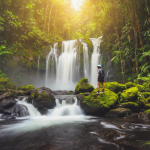
Waterfalls require intact watersheds. You cannot have a year-round, high-volume waterfall in a deforested landscape. The water table depends on forest cover, root systems that hold soil, canopy that moderates evaporation, and riparian vegetation that slows runoff and maintains stream flow. When visitors experience a functioning waterfall, they are experiencing a direct, sensory argument for forest conservation. A skilled guide can make that argument explicit in a way that no documentary or infographic ever quite achieves.
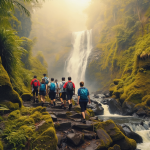
The trek to a waterfall typically passes through multiple ecological layers, secondary forest, riparian corridor, primary canopy where it remains, giving naturalist guides the opportunity to deliver environmental education across different habitat types within a single excursion. The combination of physical engagement (the hike) and aesthetic reward (the falls themselves) creates the kind of memory-forming experience that actually changes how people think about nature.
And from a conservation-economics perspective, waterfall tours generate revenue that is difficult to replicate without the ecosystem. There is no version of a waterfall tour where you’ve destroyed the forest and still have the product. That structural alignment between economic interest and conservation interest is rare and valuable.
How Ecotourism Helps Local Communities in Costa Rica
The community benefit dimension of ecotourism is the one most frequently oversimplified. “Supporting local” gets reduced to buying a souvenir from a vendor rather than a chain store, a real but limited expression of what the concept actually involves at scale.
In Costa Rica, the relationship between tourism and community development operates through several distinct mechanisms, and understanding them helps travelers make decisions that have genuine impact rather than performative ones.
Employment and Skills Development in Tourism Communities
The most direct economic channel is employment. In communities like Jacó, Tárcoles, Bijagual, and Playa Hermosa along the Central Pacific, tourism is the primary employment sector. But not all tourism employment is equivalent in its community benefit.
A locally-owned tour company that employs guides from the surrounding area, pays above minimum wage, offers training and naturalist certification support, and promotes staff into management positions creates a fundamentally different economic relationship with its community than a foreign-owned operation that imports management and uses local labor only for frontline positions.
The guides themselves represent a particularly important aspect of this dynamic. A trained naturalist guide who grew up in a community adjacent to a forest has a relationship to that forest that cannot be replicated by an imported expert. They know the trails in wet season and dry season. They know the local names for species alongside the scientific ones. They know which families have been farming the land for generations and how the landscape has changed within living memory. That knowledge is a conservation asset, and a sustainable ecotourism model treats it as one by investing in guide training, certification, and fair compensation.
The ICT requires licensed tour guides in Costa Rica to hold a formal certification from the Colegio de Guías de Turismo. This is not merely a bureaucratic formality, it represents a minimum threshold of ecological knowledge, first aid training, and professional standards that protects both visitors and the environments they’re visiting. Choosing operators who employ certified, local guides is one of the most concrete choices a traveler can make within the ecotourism framework.
Supply Chain Localization and the Multiplier Effect
When a tour operator sources food, equipment, transport, and services locally, each dollar spent on tourism cycles through the local economy multiple times before leaving the community. This multiplier effect is well-documented in tourism economics and is the reason that community-based tourism models consistently outperform enclave resort models in their development impact.
In the Jacó area, this looks like: breakfast ingredients purchased from the Mercado de Productores in San José or directly from farmers in the Puriscal highlands; transport contracted from locally-owned vehicle operators rather than national rental fleets; equipment maintained by local craftspeople; and accommodation referrals directed toward locally-owned guesthouses and small hotels rather than international chains.
For travelers, this means asking questions. Where does the food come from? Who owns the vehicles? Are the guides from this area? Operators who have genuine community integration tend to be proud of the answers and happy to explain them. Those who haven’t thought carefully about it will deflect.
Conservation Funding Through Tourism Revenue
Costa Rica’s protected area system is partially funded through entrance fees paid by visitors. The entrance fee to Manuel Antonio National Park, for example, flows through SINAC into park management, ranger salaries, and infrastructure maintenance. Every visitor who enters a national park is directly funding the institutional capacity to enforce the protections that make the park worth visiting.
Beyond official park fees, many tour operators in the region maintain voluntary contributions to local conservation projects, reforestation initiatives in degraded buffer zones, wildlife corridor restoration, sea turtle monitoring programs on the Pacific coast. These are not mandated, but they represent the genuine integration of conservation into business model that distinguishes the best operators from those who simply comply with minimum regulations.
What Responsible Travel in Costa Rica Looks Like on the Ground
Responsible travel in Costa Rica is less about what you don’t do and more about what you actively choose. The prohibitions are straightforward, don’t touch wildlife, don’t remove plants or rocks from protected areas, don’t feed animals, stay on marked trails. But the affirmative choices are where the real impact lives.
Choosing the Right Operator: A Practical Decision Framework
The single highest-leverage decision a traveler makes in Costa Rica is which tour operator to book with. Everything downstream of that choice, the quality of the environmental education, the portion of your spending that reaches local workers, the conservation contributions generated by your visit, depends on it.
| Evaluation Criterion | Green-Washing Operator | Genuinely Responsible Operator |
|---|---|---|
| Guide employment | ❌ Freelance, non-local, uncertified | ✅ ICT-certified, locally hired, naturalist-trained |
| Group size limits | ❌ Unlimited or uncapped for revenue maximization | ✅ Capped to protect trails and wildlife from disturbance |
| Trail access | ❌ Off-trail shortcuts, unregistered routes | ✅ Registered trails with SINAC or landowner agreement |
| Conservation contribution | ❌ Vague “we love nature” language | ✅ Named project, documented contribution, verifiable |
| Environmental education | ❌ Photo-op focused, minimal ecological content | ✅ Species ID, ecosystem explanation, conservation context |
| CST certification | ❌ None or unverified claim | ✅ Verified ICT CST rating visible on ICT registry |
| Local sourcing | ❌ No stated policy on supply chain | ✅ Named local suppliers, transparent about sourcing |
| Wildlife interaction policy | ❌ Animal handling for photos permitted or encouraged | ✅ Strict no-contact, observation-only policy enforced |
The operators who score consistently in the right-hand column are the ones worth booking with, not because they’re morally superior, but because they’re delivering a better experience. The environmental education is richer. The guides are more knowledgeable. The trails are better maintained. The whole product is better when the operator has thought carefully about their relationship to the ecosystem they’re selling access to.
Seasonal Awareness as a Responsible Travel Practice
Costa Rica’s two seasons have significant implications for both the visitor experience and the environmental impact of tourism. The dry season (December through April, locally called verano) brings peak visitor numbers to the Central Pacific, with Jacó and Manuel Antonio receiving their heaviest foot traffic between January and March. The rainy season (invierno, May through November) sees lower visitor density but dramatically different ecological conditions.
From a sustainability perspective, traveling during shoulder seasons (May, June, or November) distributes the economic benefits of tourism more evenly across the year, supports local businesses during their leaner months, and reduces the concentration of impact on trails and ecosystems that struggle under peak-season pressure. The waterfalls themselves are often at their most spectacular during and immediately after the rainy season, when river flow is at its highest, meaning the off-peak traveler frequently gets a superior experience alongside the reduced impact.
Trails take time to recover from compaction and erosion. Wildlife is more skittish during periods of constant high human presence. Choosing to visit during non-peak periods is a concrete, practical contribution to sustainable tourism management that requires no additional effort beyond the booking decision.
The Visitor Behavior Compact on the Trail
Once on a tour, responsible travel becomes a set of moment-to-moment choices. These are not complicated, but they do require genuine attention rather than passive compliance:
- Stay on established trails. Trail widening from social trails (paths created by visitors cutting corners or seeking better views) is one of the most persistent forms of visitor-caused habitat damage in Costa Rica’s rainforests. The extra two minutes it takes to walk the designated route is not an inconvenience, it is the actual conservation contribution the operator’s trail-use agreement with SINAC or private landowners depends on.
- Follow the guide’s cues for wildlife observation. A trained naturalist guide knows when an animal is stressed by proximity. Howler monkeys, iguanas, poison dart frogs, and the dozens of bird species you might encounter on a Central Pacific trail are not photo props. They are residents of the ecosystem you’re passing through. The guide’s instruction to stop, observe from distance, and not use flash photography is not excessive caution, it is the application of basic wildlife welfare practice.
- Carry out everything you carry in. This sounds obvious, but in practice it includes food wrappers, sunscreen applicators, and the occasional piece of gear packaging. In rainforest environments, even biodegradable materials can introduce pathogens or nutrient loads that disrupt local soil chemistry. Leave No Trace principles apply with particular force in high-biodiversity environments.
- Ask questions. Environmental education doesn’t happen passively. Guides who are trained naturalists will typically provide more depth when visitors engage with genuine curiosity. The question “what is that tree used for?” or “why is the water this color?” opens a conversation that is both personally enriching and practically useful for the guide’s ability to calibrate their educational delivery.
The Eco-Friendly Travel Costa Rica Framework: Beyond the Checklist
There is a version of eco-friendly travel that operates entirely as checklist compliance: use a reusable water bottle, don’t take wildlife selfies, tip the local guide. These are all good practices. But they represent the floor, not the ceiling, of what eco-friendly travel in Costa Rica can mean.
The ceiling involves understanding the systems you’re interacting with and making choices that reinforce rather than undermine them. It means recognizing that Costa Rica’s remarkable conservation success, the forest cover that was at roughly 21% in the 1980s and has since recovered to over 50%, happened because of deliberate policy, institutional investment, and economic incentives that made conservation more financially attractive than deforestation. Tourism is one of the primary economic engines that makes this calculation work. The way you participate in tourism either reinforces or erodes that engine.
Carbon Considerations for International Visitors
The dominant carbon impact of any international trip to Costa Rica is the flight. A round-trip flight from the eastern United States to San José (SJO) generates a carbon footprint that dwarfs all in-country decisions combined. This is not a reason to avoid the trip, it is a reason to maximize the value of the trip when you’re there, and to be honest about where the real environmental leverage lies.
Within Costa Rica, the country’s electricity grid is powered overwhelmingly by hydroelectric, geothermal, and wind generation. Electric vehicle adoption is growing rapidly in the tourism sector, with an increasing number of operators transitioning shuttle and tour fleets to EVs or hybrids. Ground transport decisions within Costa Rica have a relatively modest carbon footprint compared to the international flight, but they are still worth optimizing: shared shuttle services over private taxis where practical, and operators who have invested in low-emission transport fleets.
Some travelers choose to offset their flight emissions through verified carbon offset programs. The quality of carbon offset programs varies enormously, and the market has been subject to significant criticism. If offsetting, look for programs verified by Verra’s Verified Carbon Standard or the Gold Standard, which require third-party auditing of actual emissions reductions. Avoided deforestation projects in Costa Rica and neighboring countries are among the more credible offset categories available.
Plastic Reduction in a Rainforest Context
Costa Rica has made significant progress on single-use plastic reduction through legislation and voluntary industry adoption. Many tour operators in the Central Pacific now provide reusable water containers, use biodegradable packaging for trail snacks, and have eliminated single-use plastic from their operations.
For visitors, the practical implication is to arrive prepared: bring a reusable water bottle with a filter or UV purification capability (tap water in most of Costa Rica is potable, but remote trail water sources vary), use reef-safe, biodegradable sunscreen (conventional sunscreens contain chemicals that affect aquatic ecosystems in the rivers and pools you’ll swim in), and minimize packaging in gear brought on tour.
The rivers and waterfalls of the Central Pacific watershed, including the streams that feed the falls accessible from Jacó, drain directly into coastal marine ecosystems. Plastic and chemical inputs at the waterfall site reach the ocean within hours during rainy season high flow. The connection between trail behavior and marine health is not abstract; it is hydrological and direct.
Sustainable Adventure Travel and Personal Transformation: The Educational Dimension
There is a dimension of sustainable adventure travel that rarely appears in the policy-and-certification discussion: the personal transformation that genuine nature immersion produces in visitors, and the conservation behavior change that transformation creates over time.
This is not incidental to ecotourism. It is, in the original conception developed by conservationist Hector Ceballos-Lascuráin (who coined the term “ecotourism” in the 1980s), central to what makes the model work at a civilizational scale. Tourism that produces people who return home with a changed relationship to natural systems, who vote differently, donate differently, consume differently, and tell different stories, generates conservation value far beyond the local economic and ecological impacts of the visit itself.
What the Research Tells Us About Nature Immersion and Behavior Change
The psychological literature on nature contact and pro-environmental behavior is substantial. The American Psychological Association has documented that time in natural environments correlates with increased feelings of connectedness to nature, reduced stress and anxiety, and greater willingness to engage in conservation behaviors. Adventure tourism, which combines physical challenge with nature immersion, appears to amplify these effects by creating the kind of memorable, emotionally significant experiences that actually shift attitudes rather than merely informing them.
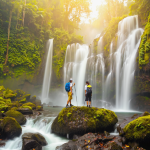
A traveler who swims at the base of a 30-metre waterfall in the Bijagual watershed, having just been walked through the ecology of the forest that creates and sustains that waterfall, leaves with a different relationship to “rainforest conservation” than they arrived with. The abstraction becomes personal. The statistics become landscape. The policy becomes something they have a stake in.
For tour operators, this means that environmental education is not a nice-to-have feature of the tour, it is the mechanism through which the full value of ecotourism is realized. A guide who knows how to connect a visitor’s wonder at a macaw in flight to the broader story of Costa Rica’s conservation recovery, and to the visitor’s own choices as a consumer and citizen, is delivering something that extends well beyond the hours of the tour itself.
Adventure as a Vehicle for Conservation Storytelling
The Central Pacific region carries extraordinary conservation stories that most visitors never hear because no one tells them in a way that connects to the physical experience. The forests above Jacó were heavily logged in the mid-20th century, and what visitors now hike through is largely secondary growth, forest that has returned over the past 40 to 60 years through a combination of natural regeneration and deliberate reforestation. This is one of the most significant forest recovery stories in tropical ecology, and it is visible on every trail in the region for those who know how to see it.
The difference in canopy height, species diversity, and structural complexity between 40-year secondary forest and old-growth primary forest is readable to an educated eye. A guide who can point to a strangler fig and explain that its presence indicates a tree large and old enough to support epiphytic colonization, which in turn requires decades of undisturbed growth, is telling the recovery story through the landscape itself. That kind of narrative is only available through on-the-ground, guided experience. It cannot be replicated by a website, a documentary, or a museum exhibit.
Cruise Passengers and Shore Excursions: A Special Case for Responsible Travel
Jacó is a significant destination for cruise passengers making shore excursions from ships docking at the nearby port of Caldera. Cruise tourism presents a particular set of challenges and opportunities within the sustainable adventure travel framework that deserve specific attention.
The challenge: shore excursion time is compressed (typically four to eight hours), which creates pressure to maximize activity density at the cost of depth. The temptation is to do a “highlights reel” tour that hits the photogenic moments without the educational and ecological substance that makes a tour genuinely ecotourism rather than simply outdoor recreation.
The opportunity: cruise passengers represent a large volume of visitors who are often encountering Central Pacific ecosystems for the first time and have no prior framework for what they’re seeing. A well-executed four-hour waterfall tour with strong naturalist guiding can be more transformative for a first-time visitor than a longer trip with weaker educational content.
For cruise passengers specifically, the operator selection decision is even more important than for independent travelers, because the compressed timeframe makes it harder to recover from a poor choice. Key criteria: Does the operator have experience with shore excursion timing? Do they guarantee return to port before ship departure? Is the guide ratio appropriate for the group size? Is the trail difficulty accurately represented for passengers who may not have prepared for significant physical activity?
The best operators in the Jacó area have extensive shore excursion experience and build their tour timing with port departure buffers factored in. That operational specificity is worth asking about explicitly when booking.
Photography, Social Media, and the Attention Economy of Ecotourism
The relationship between travel photography and sustainable tourism is more complicated than the “put down your phone and be present” discourse suggests. Thoughtful travel photography, shared on social platforms with accurate context and attribution, drives conservation awareness and generates demand for responsible tourism experiences that has real economic and policy value.
The problem is not photography, it is photography that prioritizes the image over the ecosystem. The behaviors that produce environmental damage in pursuit of the perfect shot (approaching wildlife too closely, leaving marked trails for a better angle, disturbing vegetation for an unobstructed frame) are worth avoiding not because photography is wrong but because those specific behaviors compromise both the ecosystem and the quality of the experience for other visitors.
Costa Rica’s waterfalls are among the most photographed natural features in Central America, and with good reason. The combination of lush tropical vegetation, dramatic rock formations, and cascading water creates conditions that are almost impossible to photograph badly. The best shots, consistently, are taken from the designated viewing and swimming areas, not from the scrambled-to vantage points that require trail deviation to reach.
When sharing images, context matters for the ecotourism value chain. A photo of a waterfall captioned with the operator’s name, the trail’s location (at the province or region level, not the precise GPS coordinates that can drive unmanaged visitor pressure to fragile sites), and something of the ecological story behind the image contributes to the conservation storytelling function that makes ecotourism a civilizational force rather than simply a travel category.
Making the Most of Sustainable Adventure Travel Near Jacó
The Central Pacific coast around Jacó offers a concentration of sustainable adventure experiences that is difficult to match anywhere in Costa Rica. Within a 30-kilometre radius, visitors can access:
- Waterfall trekking in the Bijagual and Tarcoles watersheds, with multiple cascades accessible on guided trails through recovering secondary forest.
- Carara National Park, one of the last remaining transition forest zones in Central America, home to scarlet macaws (one of the most visible large parrot populations in the country), crocodiles in the Tarcoles River, and a trail system maintained by SINAC rangers.
- Playa Hermosa and the marine ecosystems of the Nicoya Gulf, accessible for ocean-based excursions that complement forest experiences with Pacific coastal ecology.
- Bijagual Waterfall, at approximately 200 metres one of the tallest waterfalls in Costa Rica, accessible via guided trekking from the Central Pacific highland foothills.
- Mangrove systems in the estuaries north and south of Jacó, critical nursery habitat for marine species and home to bird communities that differ significantly from the forest interior.
The geographic concentration means that a visitor spending three to five days in the Jacó area can experience the full range of Central Pacific ecosystem types, tropical dry forest transition, humid secondary forest, riparian corridors, Pacific coastal marine, and estuarine mangrove, without the long travel times that accessing more remote regions like Corcovado or Tortuguero requires. For travelers who want genuine ecological diversity within a manageable itinerary, the Central Pacific is one of the most efficient regions in the country.
Ready to experience the Central Pacific’s waterfalls and rainforests with guides who understand both the ecology and the responsibility that comes with it? Browse the full tour selection at Costa Rica Waterfall Tours and find the experience that fits your group, your fitness level, and your appetite for adventure.
Frequently Asked Questions About Sustainable Adventure Travel in Costa Rica
What makes ecotourism in Costa Rica different from regular tourism?
Costa Rica’s ecotourism operates within a formal certification framework (the CST, administered by the ICT) that audits operators on conservation contribution, community benefit, and environmental education. This institutional structure distinguishes genuine ecotourism from simple nature-adjacent tourism, and it gives travelers a verifiable way to identify operators who meet documented standards rather than relying on marketing claims alone.
Is the Certificación para la Sostenibilidad Turística (CST) reliable?
The CST is one of the most rigorous national tourism sustainability certification programs in the world, involving on-site audits rather than self-reported data. It is not perfect, certification cycles mean some operators may hold a rating that doesn’t fully reflect current practices, but it remains a meaningful signal. Verify an operator’s current CST status through the ICT’s official registry rather than relying on claims on an operator’s own website.
What is the best time of year for sustainable adventure travel near Jacó?
From a sustainability perspective, shoulder season (May, June, or November) offers reduced pressure on trails and ecosystems, greater economic value to local communities during leaner months, and often superior waterfall experiences due to higher water flow. The peak dry season (January through March) offers the most reliable weather but the highest visitor concentration. Both have merits depending on your priorities.
How does ecotourism help local communities in Costa Rica specifically?
The primary channels are: direct employment of local residents as guides, transport operators, and hospitality staff; supply chain relationships that source food and materials from local producers; conservation fee contributions that fund protected area management; and skills development through naturalist guide training programs that create sustainable livelihoods not dependent on resource extraction. Communities adjacent to functioning ecotourism operations consistently show higher forest retention rates than comparable communities without tourism revenue, because the economic incentive structure shifts toward conservation.
Are waterfall tours in Costa Rica safe?
With a properly permitted operator employing ICT-certified guides, waterfall tours in Costa Rica are conducted within established safety protocols that include trail assessment, appropriate group-to-guide ratios, mandatory safety briefings, and equipment checks. Risks increase significantly with unlicensed operators who use unregistered trails or lack first-aid trained staff. Choosing a licensed operator is both the responsible choice and the safe one.
What should I wear and bring on a waterfall trek near Jacó?
Closed-toe shoes with grip (water shoes or trail runners, not flip-flops) are essential for wet trail conditions. Bring a dry bag for electronics, reef-safe biodegradable sunscreen, a reusable water bottle, and a lightweight rain layer, even in dry season, afternoon rain is possible in forested areas. Your operator should provide a specific packing list; if they don’t, ask for one. Operators who have thought carefully about visitor preparation are typically the same ones who have thought carefully about environmental management.
Can cruise passengers from Caldera book waterfall tours near Jacó?
Yes. Several operators in the Jacó area specialize in shore excursion logistics, with tour timing built around Caldera port schedules. The key is confirming that the operator has experience with cruise passenger timing, provides a departure buffer, and can accommodate the group size your cruise party represents. Book in advance rather than through pier vendors, who may not offer the same level of guide quality or environmental standards.
How do I know if a tour operator is genuinely committed to ecotourism or just using the term for marketing?
Ask specific questions: Which conservation project do you contribute to, and how? Can I see your CST certification number? Are your guides ICT-certified naturalists from this area? What is your maximum group size, and why? Operators with genuine commitments will answer these questions with specifics. Those using “eco” as marketing will give vague answers or redirect to testimonials. The specificity of the answer is the signal.
Does traveling in the green season (rainy season) support more sustainable tourism?
Generally, yes. Green season travel distributes tourism revenue across more of the year, reduces peak-season trail degradation, and often results in a richer ecological experience (more active wildlife, higher waterfall flows, greener landscapes). Rain in the Central Pacific typically falls in afternoon concentrated bursts rather than all-day drizzle, leaving mornings ideal for trekking. Many experienced Costa Rica travelers consider the green season their preferred time for exactly this reason.
What wildlife might I encounter on a responsible waterfall tour near Jacó?
The Central Pacific forests around Jacó are home to four species of monkey (howler, white-faced capuchin, squirrel, and spider), multiple sloth species, over 400 bird species including scarlet macaws, toucans, and motmots, numerous reptile and amphibian species including poison dart frogs, and an extraordinary diversity of invertebrates. Wildlife encounters on a guided tour are observational, no handling, no baiting, no deliberate disturbance. The guide’s role is to help you see more, not to stage encounters for photos.
How much should I tip a naturalist guide in Costa Rica?
A standard tip for a full-day guided tour in Costa Rica is $10–$20 USD per person, with more appropriate for particularly exceptional guiding. Tips represent a meaningful portion of guide income and are a direct channel for economic benefit to reach the individual who delivered the environmental education and ensured your safety on the trail. Cash in USD or Costa Rican colones is equally appreciated; many guides prefer cash over app-based payment systems.
What is the Bandera Azul Ecológica, and is it relevant to adventure tourism?
The Bandera Azul Ecológica is a Costa Rican environmental quality certification most commonly associated with beaches and communities, not individual tour operators. It signals that a beach or community meets standards for water quality, environmental management, and cleanliness. If you’re staying near a Bandera Azul-certified beach like Playa Hermosa near Jacó, it indicates a community-level commitment to environmental management that complements responsible tour operator choices.
Key Takeaways
- Sustainable adventure travel in Costa Rica operates within a formal institutional framework, the CST and SINAC management system, that gives travelers verifiable tools for evaluating operator claims rather than relying on marketing language alone.
- The operator selection decision is the highest-leverage choice a traveler makes. Certification status, guide credentials, group size policies, and conservation contribution specifics are the questions that separate genuine ecotourism from eco-aesthetic tourism.
- Waterfall tours are a particularly coherent ecotourism format because the product (the waterfall) is structurally dependent on the ecosystem (the intact forest watershed) that responsible operation protects. Economic interest and conservation interest are aligned.
- Community benefit flows through employment, supply chain localization, and conservation funding, not just tip culture. Understanding these channels helps travelers make decisions that generate systemic rather than symbolic impact.
- Shoulder season travel (May, June, November) distributes impact and often improves the experience, particularly for waterfall visits that benefit from higher water flow during and after the rainy season.
- Environmental education is not a bonus feature of ecotourism, it is a core mechanism through which the model generates conservation value beyond the local economic impact. Guides who teach are delivering the full product.
- The Jacó and Central Pacific region offers exceptional ecological diversity within a compact geography, making it one of the most efficient regions in Costa Rica for visitors who want authentic, multi-ecosystem adventure experiences without extensive internal travel.
Sustainable adventure travel, practiced genuinely, is not a sacrifice of experience for principle. It is the recognition that the best experiences, the ones that stay with you, that change how you see things, that make you want to return, are the ones rooted in real places, real ecosystems, and real human knowledge about both. In Costa Rica’s Central Pacific, those experiences are available. Explore the guided adventure tours offered by Costa Rica Waterfall Tours and start planning the kind of trip that means something.
About the author
Costa Rica Waterfall Tours Editorial Team · Editorial Team
Book Your Guided Waterfall Adventure