Here is a question most travelers never think to ask before booking: are you paying for Costa Rica, or are you paying for a version of Costa Rica that has been sanded down, fenced in, and turned into a product? The difference matters more than the price tag, and it shows up most clearly when you compare what happens inside an adventure park versus what happens on a guided waterfall tour into the real rainforest. Both options exist in and around Jacó. Both market themselves as authentic Costa Rican adventure. But they are fundamentally different experiences, and choosing the wrong one can leave you with a collection of GoPro clips and a nagging feeling that the jungle was always just out of reach.
This comparison is not about declaring one category universally superior. It is about helping you understand exactly what each option delivers, where the value lies, and which experience actually puts you in contact with the biodiversity, raw beauty, and ecological complexity that makes Costa Rica worth visiting in the first place. Whether you are a cruise passenger with six hours in port at Jacó, a family planning a week on the Central Pacific coast, a solo adventure traveler, or a group coordinator building an itinerary, this breakdown will give you the information to make a genuinely informed decision.
What “Authentic Costa Rica” Actually Means (And Why It Gets Marketed Poorly)
Before comparing specific options, it is worth interrogating the phrase “authentic experience” because it appears in virtually every tour brochure and booking platform in the country. Costa Rica’s official tourism body, the Instituto Costarricense de Turismo (ICT), distinguishes between mass tourism products and experiential ecotourism in its national tourism strategy, and that distinction tracks closely to the adventure park versus guided waterfall tour divide.
Authentic, in the Costa Rican ecotourism context, means three things. First, contact with ecosystems that function naturally, not ecosystems that have been modified for visitor convenience. Second, knowledge transfer, where a guide with genuine expertise in local flora, fauna, and culture contextualizes what you are seeing. Third, economic benefit that flows to local communities and conservation efforts rather than exclusively to a centralized commercial operator.
Adventure parks tend to score well on convenience and safety infrastructure. Guided waterfall tours, when run by experienced operators with genuine ecological knowledge, tend to score well on all three authenticity markers. The honest overlap is narrower than either side of the market would like to admit.
The Central Pacific region, anchored by Jacó and extending south through Herradura, Tárcoles, and the Fila Costeña, contains some of the most ecologically significant terrain in the country. The rivers that feed into the waterfalls in this zone flow through primary and secondary forest that sits at the edge of protected zones managed by SINAC (Sistema Nacional de Áreas de Conservación). That context, the living, working watershed, the bird corridors, the amphibian populations, the strangler figs and cecropia canopy, is what a well-run guided tour puts you inside. An adventure park, by design, puts you adjacent to it.
Adventure Parks Near Jacó: What You Actually Get
Adventure parks in and near Jacó are purpose-built outdoor activity centers that consolidate multiple adrenaline experiences on a single property. They are engineered for throughput and designed to serve high visitor volumes efficiently. The typical offering includes zip-lining, hanging bridges, rappelling, ATV circuits, and sometimes a waterslide or bungee component. Some properties include a natural feature like a small waterfall or river section, but these are generally accessed via maintained boardwalks or viewing platforms rather than through any meaningful trekking.
The Typical Adventure Park Structure
Most adventure parks operate on a package pricing model. You select a bundle of activities at the entrance, pay a consolidated fee (commonly ranging from $60 to $150 USD per person depending on which activities are included), and then rotate through stations with groups of other visitors. Guides at each station are activity-specific: the zip-line instructor is not the same person as the rappel guide, and neither is likely to offer substantive ecological interpretation of the landscape you are moving through. That is not a criticism of the individual guides; it reflects the operational model.
Zip-line infrastructure at established parks in the Jacó area is generally well-maintained and certified. Lines run through the forest canopy, which does provide genuine aerial perspective on the landscape. The view is real. The forest is real. But the experience is structured around the activity itself rather than around the ecosystem, and the time you spend actively engaging with the natural environment is limited to what is visible from the cable.
Pros of the Adventure Park Model
- Predictability: You know exactly what activities you will complete, in what order, and roughly how long each takes. This suits cruise passengers with hard return windows and families with young children who need reliable scheduling.
- Weather resilience: Parks operate with covered stations and paved or well-graded paths, making them more functional during the rainy season (May through November) when trail conditions at natural waterfall sites can be more demanding.
- Multi-activity consolidation: If your group has mixed interests, a park lets everyone check multiple boxes in a single half-day without coordinating separate bookings.
- Safety infrastructure: Established parks invest heavily in equipment inspection, harness fitting, and staff certification. The physical risk management is mature at reputable operators.
Cons and Honest Limitations
- Ecological disconnection: The natural environment is a backdrop, not the experience itself. You are moving through engineered routes designed for activity delivery, not ecological immersion.
- Group volume: Popular parks in the Jacó area see large numbers of visitors per day, particularly during the dry season (December through April). The experience during peak hours can feel more like a theme park queue than a nature adventure.
- Limited knowledge transfer: The guides are primarily safety and activity specialists. Detailed interpretation of the watershed, bird species, or forest ecology is rarely part of the standard experience.
- Environmental impact concerns: High visitor volume concentrated on modified terrain creates compaction, erosion, and noise disturbance in ways that differ meaningfully from smaller-group guided tours on natural trails.
Who the Adventure Park Model Actually Suits
Adventure parks are genuinely the right call for specific traveler profiles. Families with children under ten who need predictable, controlled environments. Cruise passengers from Caldera Port (approximately 20 km from Jacó) with five to six hours in port who cannot afford logistical uncertainty. Groups with highly mixed fitness levels where a natural waterfall hike would leave some members struggling. Travelers who prioritize activity quantity over ecological depth. If you identify with any of these, a well-run adventure park delivers real value without pretending to be something it is not.
Guided Waterfall Tours in Costa Rica: What Actually Happens on the Trail
A guided waterfall tour is a fundamentally different product category, even when it includes zip-lining or rappel components. The distinction is not just about destination; it is about the structure of the experience and the relationship between the visitor and the landscape.
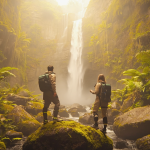
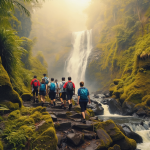
On a quality guided waterfall tour operating out of Jacó, the journey begins before you reach the waterfall. The approach involves a trekking section through working rainforest, not a manicured path, but a trail system that follows natural topography along river corridors or ridge lines. The guide who walks with you from start to finish carries ecological knowledge that is genuinely contextual: they know what the strangler fig at kilometer one is doing to the host tree, they can identify the call of the motmot overhead, they understand the hydrology of the watershed you are entering. That continuity of interpretation transforms what you are seeing from scenery into a living system.
The Waterfall as Destination and Context
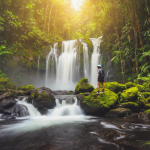
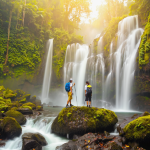
The waterfalls accessible via guided tours in the Central Pacific region vary considerably in character. Some are single-drop cataracts of 20 to 40 metres falling into deep swimming pools, surrounded by moss-covered basalt and tree fern. Others are multi-tiered cascades where each level has its own microclimate and visual character. The rivers feeding these falls drain the Fila Costeña, a coastal mountain range that intercepts significant rainfall year-round and supports exceptionally high biodiversity.
Arriving at a waterfall on foot, having trekked through the forest to reach it, produces a qualitatively different psychological response than arriving via ATV or being dropped at a viewing platform. The physical effort of the approach, combined with the progressive revelation of the landscape, creates genuine emotional engagement with the place. This is not marketing language; it reflects well-documented principles in environmental psychology about how effort and anticipation shape the perceived value of natural experiences.
What Quality Guided Tours Include (and What to Verify)
Not all guided waterfall tours are equal, and travelers should ask specific questions before booking. A high-quality operator running adventure tours in Jacó, Costa Rica will provide:
- A single lead guide who accompanies the group for the entire tour duration, not rotating station specialists
- Clear pre-tour briefing on trail conditions, required footwear, and safety protocols
- Appropriately sized groups (typically six to twelve people) that allow genuine interaction and ecological interpretation without overwhelming the site
- Transparent information about the physical demands of the trek (elevation gain, trail surface, approximate time on trail)
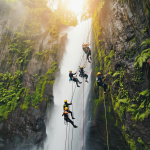
- Safety equipment appropriate to the site, including harnesses and helmets where rappel or descent components are included
- Environmental guidelines consistent with SINAC’s visitor management standards for protected area access
The Photography Dimension
For travel photographers, the guided waterfall tour is not even a close comparison. Waterfalls in the Central Pacific zone offer conditions that adventure parks simply cannot replicate: natural light filtering through forest canopy, long-exposure opportunities at falls with consistent flow, foreground interest from ferns and mosses, and the absence of artificial infrastructure in the frame. The visual output from a well-timed waterfall tour during the early rainy season, when flow is highest and the forest is intensely green, is in a different category from anything producible inside a park environment.
Pros of Guided Waterfall Tours
- Genuine ecological immersion: You are inside a functioning natural system, not adjacent to one.
- Knowledge depth: A single expert guide providing continuous interpretation throughout the experience creates lasting learning, not just momentary sensation.
- Smaller group dynamics: Intimate groups allow for personalization, pacing adjustments, and genuine interaction that large park operations cannot offer.
- Conservation alignment: Revenue from responsible guided tours supports local guides and, when operators follow ecotourism principles, contributes to the economic case for forest protection in the watershed.
- Physical and mental engagement: The combination of trekking, swimming in natural pools, and navigating real terrain produces a more complete physical experience than activity-station rotation.
Honest Limitations to Acknowledge
- Weather sensitivity: Natural trail conditions during heavy rainy season rainfall can be challenging. Responsible operators communicate this clearly and have contingency protocols, but some days are genuinely difficult.
- Fitness requirement: Most quality waterfall tours involve at least 30 to 90 minutes of hiking over uneven terrain. This is not suitable for all fitness levels, and operators should be honest about what is required.
- Less predictable timing: Natural experiences do not run on a fixed clock. A waterfall tour may run longer or shorter depending on conditions and group dynamics, which can complicate tight schedules.
- Activity variety: If your group wants to do zip-lining, ATV, and waterfall swimming in one session, a standalone waterfall tour may not consolidate all of that. Some operators do combine activities, but verify specifics before booking.
Head-to-Head Feature Comparison
The table below compares the two experience categories across the dimensions that matter most for travelers planning outdoor adventures in Costa Rica. These are general characteristics based on how each model typically operates; individual operators within each category will vary.
| Dimension | Adventure Park (Jacó Area) | Guided Waterfall Tour |
|---|---|---|
| Natural immersion | ⚠️ Partial (engineered environment with natural backdrop) | ✅ Full (active engagement with natural ecosystem) |
| Ecological interpretation | ❌ Minimal to none | ✅ Core part of the experience |
| Group size | ⚠️ Large (20–50+ at peak times) | ✅ Small (6–12 typical) |
| Activity variety | ✅ High (zip-line, ATV, rappel, bridges, etc.) | ⚠️ Moderate (trekking, swimming, sometimes rappel) |
| Schedule predictability | ✅ High (fixed station rotation) | ⚠️ Moderate (nature-dependent timing) |
| Fitness requirement | ✅ Low to moderate | ⚠️ Moderate (varies by site) |
| Photography quality | ⚠️ Good (aerial views from zip-line) | ✅ Exceptional (natural light, unspoiled settings) |
| Conservation impact | ⚠️ Varies by operator | ✅ Strong when operator follows ecotourism principles |
| Typical price range (USD) | $60–$150 per person | $65–$130 per person |
| Cruise passenger suitability | ✅ High (predictable duration) | ✅ High (with experienced operator who manages timing) |
| Family-friendly (ages 6+) | ✅ Yes (controlled environment) | ✅ Yes (with operator guidance on appropriate tours) |
| Memorable factor (long-term) | ⚠️ Moderate | ✅ High |
The Environmental Impact Question: Why It Matters More Than Most Travelers Realize
Costa Rica has built its global tourism identity on environmental stewardship. The country protects over 25% of its national territory in parks, reserves, and biological corridors managed through SINAC and MINAE (Ministerio de Ambiente y Energía). That protection is not static; it is actively maintained and requires ongoing economic justification. Ecotourism, when practiced responsibly, generates that justification by demonstrating that standing forest is more economically productive than converted land.
The Certificación para la Sostenibilidad Turística (CST), administered by the ICT, provides a framework for evaluating tourism operators on environmental impact, social contribution, and service quality. Operators certified at higher CST levels are required to demonstrate measurable practices around waste management, water use, local hiring, and biodiversity protection. When choosing between an adventure park and a guided tour operator, checking CST certification status is one of the most reliable ways to assess genuine environmental commitment versus marketing language.
Adventure Parks and Land Use
Adventure parks require permanent infrastructure: zip-line towers, access roads, parking areas, food service facilities, restrooms, and maintenance zones. This infrastructure involves land clearance and impermeable surface creation that alters hydrology on the property. Well-managed parks plant buffer vegetation and manage runoff, but the fundamental land-use model is more intensive than guided tours that operate primarily on existing trail networks.
This is not an argument that adventure parks are environmentally irresponsible. It is an observation that the infrastructure model has a different and generally larger footprint than the guided tour model, and that footprint should factor into the decision for travelers who prioritize conservation alignment.
Guided Tours and Carrying Capacity
Guided waterfall tours have their own environmental management obligations. Responsible operators limit group size to protect trail surfaces and minimize disturbance at waterfall sites, particularly during nesting seasons for birds like the resplendent quetzal (found at higher elevations) or the bare-throated tiger heron that frequents river corridors in the Central Pacific. Operators should also follow leave-no-trace principles and avoid habituating wildlife to human presence through feeding or close approach protocols.
The key variable is operator quality. A poorly run guided tour with oversized groups, no site rotation, and guides who prioritize speed over ecological care can degrade natural sites faster than a well-managed park. This is why operator selection, not just tour category, is the critical decision.
Pricing Breakdown and Value Assessment
Price parity between the two categories is closer than most travelers expect. The perception that adventure parks are budget options and guided tours are premium products does not hold up when you compare what you receive per dollar spent.
| Experience Type | Typical Price Range (USD/person) | Duration | What’s Typically Included |
|---|---|---|---|
| Basic adventure park package | $60–$90 | 3–4 hours | 3–4 zip-line cables, hanging bridges, safety gear |
| Full adventure park package | $110–$150 | 5–7 hours | Zip-line, ATV, rappel, lunch, transport |
| Guided waterfall tour (standard) | $65–$100 | 4–6 hours | Guided trek, waterfall swimming, snacks, transport |
| Costa Rica adventure package (multi-activity) | $100–$130 | 5–8 hours | Waterfall trek, rappel, zip-line, lunch, transport, expert guide throughout |
| Private guided waterfall tour | $150–$220 (group) | 5–8 hours | Fully customized itinerary, private guide, full transportation |
When you factor in the depth of experience per dollar, the guided Costa Rica adventure packages that combine waterfall trekking with additional activities represent genuinely strong value. You are getting continuous expert interpretation, small-group dynamics, natural site access, and the physical and emotional engagement of a real trek, for a price point that competes directly with mid-range park packages.
Scenario-Based Decision Framework
Rather than making a blanket recommendation, this framework maps specific traveler scenarios to the experience type that genuinely fits best. Use this as a decision tool, not a rigid prescription.
Scenario 1: Cruise Passenger with 5–6 Hours in Port
Cruise ships calling at Caldera, approximately 20 km from Jacó, give passengers roughly five to six usable hours when transportation time is factored out. Both adventure parks and guided waterfall tours can work in this window, but the key variable is operator reliability. An experienced guided tour operator who understands port logistics, maintains a firm return timeline, and has contingency protocols for trail conditions is equally reliable to a park. The decisive factor here is not tour type; it is operator track record. Look for operators with verified five-star reviews from cruise passengers specifically, and confirm the operator’s return guarantee in writing.
Scenario 2: Family with Children Ages 6–14
Families with this age range have more flexibility than parents often assume. Children aged 8 and up can comfortably complete most standard waterfall treks if the guide manages pacing appropriately. The waterfall swimming experience, in particular, is one of the genuinely transformative family travel experiences available in Costa Rica: children remember it for years in a way that zip-line photos do not always sustain. Adventure parks offer the reassurance of controlled environments and may be preferable for families with children under 8 or with mobility considerations. For children 8 and older who are reasonably active, a guided waterfall tour is the stronger memory-maker.
Scenario 3: Couple Seeking a Unique Nature Experience
For couples, and particularly for those celebrating anniversaries, honeymoons, or milestone trips, the guided waterfall tour is not a comparison; it wins decisively. The intimacy of a small group or private tour, the natural beauty of the waterfall setting, the physical experience of trekking together and arriving at something genuinely spectacular, this creates the kind of shared memory that defines a trip. Adventure parks can be fun as a couple, but they are rarely intimate or particularly memorable in the way that reaching a 35-metre waterfall after a forest trek is.
Scenario 4: Group of Friends or Corporate Team (10–20 People)
Large groups have specific logistics needs that both operators can accommodate, but differently. Adventure parks handle large groups efficiently through their station rotation model; the group does not need to move together in the same way, which can actually reduce cohesion as a team experience. A well-run guided tour with two or three guides for a large group maintains collective energy and creates shared challenges, which is why corporate incentive travel coordinators who prioritize team dynamics often prefer the guided tour format. The physical challenge of the trek, with encouragement between colleagues, builds genuine camaraderie that a zip-line cable does not.
Scenario 5: Solo Adventure Traveler
Solo travelers benefit most from the social structure of a small guided tour group. Joining a guided waterfall tour as a solo traveler typically means joining a group of six to twelve others, which creates organic social interaction in a way that rotating through park stations alone does not. The shared experience of a challenging trek and the reward of the waterfall creates conversation and connection. Many solo travelers report that the guided tour format is one of the best ways to meet other travelers with similar interests.
Scenario 6: Photography-Focused Traveler
For anyone whose primary goal is creating compelling images of Costa Rica’s natural environment, the guided waterfall tour is the only serious option. Natural waterfalls in the Central Pacific zone, particularly during the early rainy season when flow is at peak and the forest is intensely saturated with green, offer photographic conditions that purpose-built parks cannot approach. The guide can position the group to maximize light angles, provide context about the best timing for long-exposure shots, and identify secondary subjects (birds, insects, plants) that add depth to a visual portfolio.
The Operator Quality Variable: Why Who You Book With Matters More Than What You Book
Across both categories, the single biggest determinant of experience quality is operator competence and ethics. A well-run adventure park with safety-first culture and knowledgeable staff will outperform a poorly run guided tour every time. Conversely, an experienced guided tour operator with deep ecological knowledge, genuine safety protocols, and a strong conservation ethic will outperform a mediocre adventure park regardless of the category comparison.
For travelers considering guided waterfall tours in Costa Rica, here are the specific quality signals to evaluate before booking:
- Guide tenure and local knowledge: How long have the guides been operating in the Central Pacific region? Do they speak confidently about the specific watershed, the species present, and the seasonal variations? Guides who have spent years on the same trails develop knowledge that is genuinely irreplaceable.
- Review specificity: Generic five-star reviews saying “amazing experience” tell you less than reviews that describe specific moments, interactions with the guide, and ecological details noticed on the trail. Look for the latter.
- Group size policy: Operators who cap group sizes are making a choice that costs them revenue in the short term. That choice signals genuine commitment to experience quality and site conservation.
- Pre-tour communication: Does the operator send detailed preparation information before the tour? Information about footwear, what to bring, physical requirements, and what to expect demonstrates professionalism and care for the guest experience.
- Safety equipment and protocols: For tours involving any rappel, descent, or water crossing component, ask specifically about equipment inspection frequency, guide certification, and emergency protocols. Reputable operators answer these questions without hesitation.
Costa Rica Waterfall Tours operates out of Jacó with precisely this standard of operator quality in mind. Their guided experiences are designed for genuine ecological immersion, with guides who carry real expertise in the Central Pacific watershed, group sizes managed for intimacy and site protection, and pre-tour communication that prepares guests thoroughly for what they will encounter. You can explore the full range of available adventure tours in Jacó, Costa Rica to find the option that fits your group’s specific needs.
Seasonal Considerations for Jacó Adventure Planning
Costa Rica’s two seasons shape the adventure experience in ways that many travelers underestimate. The dry season, called verano, runs from December through April and brings reliable sunshine, lower river levels, and firm trail conditions. The rainy season, invierno, runs from May through November and delivers afternoon thunderstorms, higher waterfall flow, intensely lush vegetation, and significantly fewer tourists.
For adventure parks, the dry season is operationally easier: zip-lines run without weather interruptions, ATV trails are firmer, and scheduling is more predictable. During the rainy season, parks typically operate through light rain (gear up and continue) but may pause for electrical storms.
For guided waterfall tours, the calculus is more nuanced. The rainy season, counterintuitively, often delivers the most spectacular waterfall experiences. Flow is at its peak, the forest is extraordinarily green, the light is soft and diffused (excellent for photography), and wildlife activity is high as animals respond to the productivity of the wet season. The trade-off is that trail conditions require more care, proper footwear becomes essential rather than advisable, and some days are simply too wet to operate safely. Experienced operators manage this well by monitoring conditions, maintaining flexible scheduling, and communicating clearly about what guests should expect and prepare for.
The Jacó area sits in a zone that receives significant rainfall throughout the year, even during the dry season, so neither category is “rain-proof.” What matters is how the operator responds to weather, not whether they can guarantee sunshine.
What the Five-Star Review Pattern Actually Reveals
Across booking platforms including TripAdvisor and Viator, a consistent pattern emerges when you read the actual text of high-rated reviews for guided waterfall tours versus adventure parks: the language is fundamentally different. Adventure park reviews frequently use words like “fun,” “exciting,” “worth it,” and “great for the family.” Guided waterfall tour reviews, particularly from experienced travelers and ecotourism enthusiasts, use words like “unforgettable,” “life-changing,” “nothing like I expected,” “the guide made everything,” and “I felt like I was actually in Costa Rica.”
That language difference is not marketing. It reflects a genuine difference in what the two experience types deliver at their best. Adventure parks reliably deliver fun. Guided waterfall tours, when run well, deliver something closer to revelation: a direct encounter with one of the most biodiverse and ecologically intact landscapes on the planet, mediated by someone who genuinely understands and loves it.
This is what “authentic Costa Rica experience” actually means in practice, and why, for travelers whose goal is to understand and feel this place rather than simply to have done activities in it, the guided waterfall tour is the stronger choice.
Frequently Asked Questions
Is an adventure park in Jacó or a guided waterfall tour better for first-time visitors to Costa Rica?
For first-time visitors who want to genuinely understand what makes Costa Rica extraordinary, a guided waterfall tour delivers more lasting value. The ecological immersion, expert interpretation, and direct contact with the natural landscape create a foundation for understanding the country that adventure park activities, however fun, do not replicate. If your group includes young children or has significant scheduling constraints, an adventure park is a reliable choice; otherwise, the waterfall tour experience tends to produce the stories that first-time visitors tell for years afterward.
Are guided waterfall tours near Jacó safe for non-athletic travelers?
Most reputable operators offer tours across a range of difficulty levels. Standard waterfall tours in the Central Pacific region typically involve 30 to 90 minutes of hiking on uneven natural trails, which is manageable for most adults with reasonable mobility. The key is to communicate honestly with the operator about your fitness level and any physical limitations before booking. Quality operators will match you to the appropriate tour rather than oversell a challenging experience.
Can cruise passengers from Caldera do a guided waterfall tour and return to port on time?
Yes, with the right operator. Experienced tour companies running adventure tours in Jacó, Costa Rica understand port schedules and build return buffer time into their itineraries for cruise passengers. Confirm that your operator has explicit experience with cruise excursions, verify their return guarantee policy, and book with operators who have positive reviews specifically from cruise passengers. The Caldera to Jacó drive is approximately 20 to 25 minutes, giving reasonable flexibility.
How does weather affect guided waterfall tours during the rainy season?
The rainy season (May through November) brings higher waterfall flow, lush green landscapes, and fewer crowds, making it an excellent time for tours despite the rain. Afternoon rainfall is common but predictable; most tours operate in the morning and are largely complete before peak afternoon storms. Responsible operators monitor conditions daily and communicate any changes to guests. Proper waterproof gear and appropriate footwear (closed-toe, grippy-soled) make the experience comfortable even in wet conditions.
What is the typical group size for a guided waterfall tour?
Quality operators cap group sizes at 6 to 12 participants for standard tours, with larger groups split across multiple guides. This intimate scale allows the guide to provide genuine ecological interpretation to every person in the group and ensures that the natural site is not overwhelmed. If an operator does not mention group size limits in their booking information, ask directly before committing.
Are there adventure packages that combine waterfall tours with other activities like zip-lining?
Yes. Several operators, including Costa Rica Waterfall Tours, offer Costa Rica adventure packages that combine waterfall trekking with rappelling, zip-lining, and other activities in a single guided experience. These packages provide activity variety while maintaining the continuous expert guide and ecological context that distinguishes a guided tour from a park rotation. They are a strong option for travelers who want multi-activity value without sacrificing the immersive quality of the guided format.
What should I wear and bring for a guided waterfall tour near Jacó?
Closed-toe shoes with good grip are essential, either trail runners or light hiking boots. Avoid flip-flops or sandals on natural trails. Bring a swimsuit to wear under quick-dry clothes, a small dry bag or waterproof case for electronics, sunscreen, insect repellent, and a water bottle. Your operator should provide a detailed packing list before the tour; if they do not send one proactively, ask for it when you book.
How does the environmental impact of guided tours compare to adventure parks?
Guided tours operating with small groups on natural trail systems generally have a lower per-visit environmental footprint than park infrastructure, which requires permanent land modification. However, the responsible practices of the individual operator matter more than the category. Look for operators with CST (Certificación para la Sostenibilidad Turística) certification or those who explicitly describe their environmental management practices, including group size limits, waste protocols, and guide training on wildlife interaction guidelines.
Is it worth booking a private guided waterfall tour versus joining a group tour?
Private tours are worth the premium for couples celebrating special occasions, photographers with specific timing or shot requirements, corporate teams, or groups with particular pace preferences. They allow complete customization of the itinerary, timing, and focus. Group tours are excellent for solo travelers and small groups who enjoy meeting other adventure travelers and are comfortable with shared pacing. Most operators offer both formats.
What is the best time of year for waterfall tours in the Jacó area?
Both seasons have genuine appeal. The dry season (December through April) offers reliable weather and firm trails. The early rainy season (May through July) delivers peak waterfall flow and intense green vegetation with generally manageable rain. Mid-rainy season (August through October) can bring heavier rainfall but also dramatically higher waterfall volume. November marks the transition back toward the dry season. Many experienced waterfall tour guests prefer the rainy season specifically for the visual intensity of the landscape.
Do guided waterfall tours in Costa Rica contribute to local conservation?
When operated responsibly, yes. Guided ecotourism tours generate income for local guides, support the economic case for forest protection in the watershed, and, through operators committed to ecotourism principles, can contribute directly to conservation programs. The connection between tourism revenue and forest protection is one of the core mechanisms that has made Costa Rica’s conservation model one of the most successful in the world. Choosing operators with transparent environmental practices amplifies this contribution.
How far in advance should I book adventure tours in Jacó?
During the dry season (December through April), booking 2 to 4 weeks in advance is advisable, particularly for weekends and around major holidays. During the green season, availability is more flexible, though booking at least a week ahead is still recommended to secure your preferred date and allow time to receive pre-tour preparation information. Private tours for large groups should be booked 4 to 6 weeks in advance regardless of season.
Key Takeaways
- Adventure parks and guided waterfall tours are genuinely different product categories, not just different price points. Understanding the difference before booking prevents disappointment.
- Guided waterfall tours deliver higher ecological authenticity, continuous expert interpretation, and more lasting memorability for most traveler types.
- Adventure parks are the right call for very young children, travelers with significant mobility limitations, or those with hard scheduling constraints who need maximum predictability.
- Operator quality matters more than category. A mediocre guided tour is worse than a well-run adventure park. Research operators specifically, not just tour types.
- The rainy season offers spectacular waterfall conditions and should not be automatically dismissed by travelers planning Central Pacific adventures.
- Price parity is closer than expected between mid-range park packages and quality guided tour packages, making the decision about experience type rather than budget.
- CST certification and specific review language are the two most reliable quality signals when evaluating operators in either category.
- Costa Rica Waterfall Tours offers guided waterfall and multi-activity adventure experiences from Jacó with the operator quality, group size management, and ecological expertise that the guided tour category requires to deliver on its promise.
Ready to experience the real Costa Rica rather than a version of it? Explore the full range of adventure tours in Jacó offered by Costa Rica Waterfall Tours and find the guided experience that matches your group, your timeline, and your appetite for the extraordinary.
About the author
Costa Rica Waterfall Tours Editorial Team · Editorial Team
Book Your Guided Waterfall Adventure